Best Forex Brokers with Low Minimum Deposit
 Beatrice Quinn
 Robert J. Williams
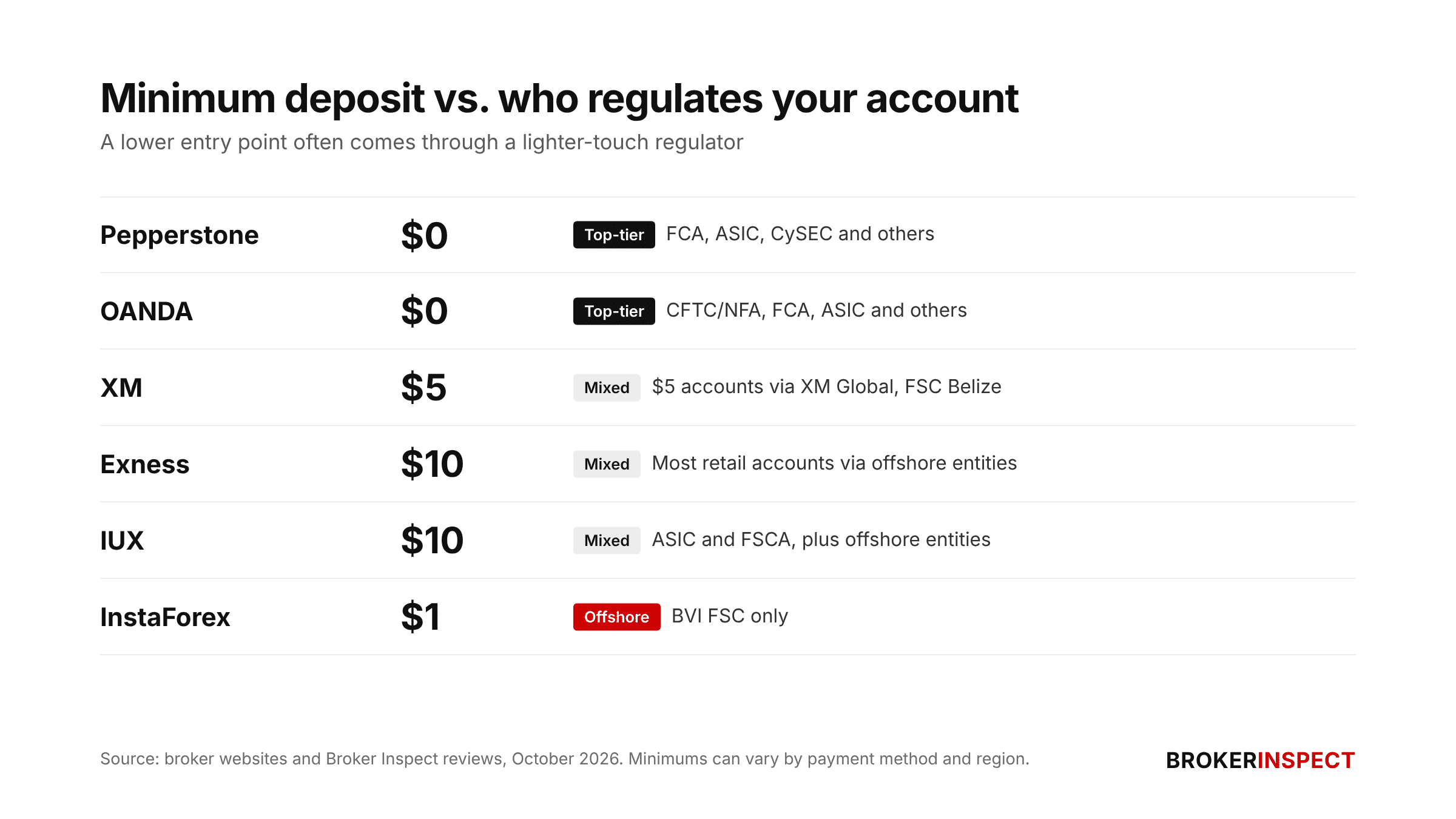
Forex brokers with low minimum deposits let you open a live account with $0 to $10. Pepperstone and OANDA don’t set a minimum at all, XM starts at $5, Exness and IUX at $10, and InstaForex at $1.
The deposit figure is only half the story. The cheapest entry points usually come through offshore entities with lighter rules, and a $10 balance limits which trades you can place. This guide compares six brokers, explains who regulates each account, and shows how far a small deposit really goes.
Key Takeaways
- A $0 minimum deposit doesn’t mean you can trade with nothing, because every trade still needs margin.
- The lowest entry points often come through offshore entities, so check which company holds your account.
- A cent account is the only practical way to manage risk on a balance of around $10.
- Under top-tier leverage limits, a micro lot needs more margin than a $10 account holds.
- Pick the broker on regulation and total cost first, and treat the minimum deposit as a tiebreaker.
Quick Comparison: Forex Brokers with Low Minimum Deposit
| Broker | Min. deposit | Smallest trade | Regulation (entity most readers join) | Best for |
| Pepperstone | $0 | 0.01 lot | Top-tier: FCA, ASIC, CySEC and others | Regulated trading from any amount |
| OANDA | $0 | Varies by region | Top-tier: CFTC/NFA, FCA, ASIC and others | Beginners in regulated markets |
| XM | $5 | 0.01 lot | FSC Belize (XM Global) | Micro lots on a small budget |
| Exness | $10 | 0.01 cent lot | Mostly offshore entities | Cent account trading |
| IUX | $10 | 0.01 lot | ASIC, FSCA, plus offshore entities | Low-cost Standard account |
| InstaForex | $1 | 0.01 cent lot | BVI FSC only | The lowest possible entry point |
Minimums can change, depending upon your payment method and country, so always confirm the figures shown on the broker’s deposit page.
How We Chose These Brokers
We started with minimum deposit forex brokers that publish an entry point of $10 or less on their own websites. Then, we checked each one against five things:
1. Regulation: which company and which regulator would hold your account, not just the best licence the group owns.
2. Total cost at small sizes: spreads and commissions on 0.01-lot trades, plus any inactivity fees.
3. Small trade sizes: whether you can trade micro lots or use a cent account.
4. Withdrawals: minimum withdrawal amounts and fees, which can eat a small balance fast.
5. Risk protection: negative balance protection and how leverage is set for retail clients.
| How our team checks a low-deposit broker: When our team reviews a broker, we look at the deposit page inside the client area, not just the marketing page. The actual minimum often depends on the payment method, and card deposits can start higher than the headline figure. We also read the client agreement to see which entity signs it. A brand can hold an FCA licence and still open most international accounts through an offshore company, and that company sets your protections. |
The 6 Best Forex Brokers with Low Minimum Deposit
1. Pepperstone: Best for Regulated Trading From Any Amount
Minimum deposit: $0 on both the Standard and Razor accounts. If you choose to fund the account, Pepperstone’s account page says the smallest top-up is $10 or your local equivalent.
Regulation: licensed by the FCA, ASIC, CySEC, and several other regulators, so most clients join a top-tier entity.
Costs: the Standard account builds the cost into the spread, while Razor charges a commission on tighter spreads.
Our take: this is the strongest choice if you want a small start without giving up regulatory protection. See our full review of Pepperstone.
Pros: top-tier regulation, $0 minimum, micro lots from 0.01.
Cons: leverage is capped for retail clients, so a very small balance can’t open many trades.
2. OANDA: Best for Beginners in Regulated Markets
Minimum deposit: OANDA doesn’t set a minimum deposit.
Regulation: Regulated by the CFTC and NFA in the US, the FCA in the UK, ASIC in Australia, and others.
Costs: spread-based pricing on its standard account, with a commission option in some regions.
Our take: OANDA suits beginners in the US and UK who want a well-known regulated broker and a clean platform. Leverage follows local rules, such as 50:1 on major pairs in the US and 30:1 in the UK. Read our OANDA review for platform details.
Pros: $0 minimum, strong regulation, available to US traders.
Cons: the account mix and fees differ by country, so check your local OANDA site.
3. XM: Best for Micro Lots on a Small Budget
Minimum deposit: $5 on the Standard and Ultra Low accounts, according to XM’s account types page.
Regulation: The $5 accounts are offered by XM Global, regulated by the FSC of Belize. XM’s EU and Australian entities, regulated by CySEC and ASIC, set their own terms.
Costs: The Standard account is commission-free, with costs in the spread.
Our take: XM makes sense if you want 0.01-lot trades from a few dollars. Just know that the $5 offer comes through its offshore entity. More in our XM review.
Pros: $5 entry point, micro lots, commission-free Standard account.
Cons: the low minimum comes with lighter regulation than XM’s EU and Australian arms.
4. Exness: Best for Cent Account Trading
Minimum deposit: from $10 on the Standard and Standard Cent accounts, though the exact figure depends on your payment method. Pro, Zero and Raw Spread accounts start higher.
Regulation: the group holds FCA and CySEC licences, but most retail clients outside Europe open accounts with its offshore entities, such as the Seychelles FSA.
Costs: the Standard and Standard Cent accounts are commission-free.
Our take: the Standard Cent account is the main draw. It shows your balance in cents, so a $10 deposit appears as 1,000 cents and each trade is tiny. Our Exness review covers each entity in detail.
Pros: true cent account, standard and cent accounts both from $10.
Cons: most international clients sit under offshore regulation, and leverage can be very high.
5. IUX: Best for a Low-Cost Standard Account
Minimum deposit: $10 for the Standard account, and $500 for the Pro and Raw accounts.
Regulation: IUX entities hold licences from ASIC (No. 529610), South Africa’s FSCA (FSP No. 53103), and Mauritius’s FSC, and it also operates a St. Vincent and the Grenadines registration. Which one holds your account depends on where you live.
Costs: the Standard account is commission-free, with spreads from 0.2 pips, based on our review.
Our take: IUX gives small accounts tighter pricing than most $10 brokers. Leverage of up to 1:3000 is available through some entities, which is far more than a beginner should use. See our IUX review.
Pros: low-cost Standard account from $10, ASIC and FSCA licences in the group.
Cons: very high leverage on offshore accounts, and it isn’t available in the US, UK, and some EU countries.
6. InstaForex: Best for the Lowest Possible Entry Point
Minimum deposit: from $1 on the Insta.Standard and Insta.Cent accounts, depending on the payment system, per InstaForex’s account types page.
Regulation: InstaForex is regulated only by the British Virgin Islands FSC (licence SIBA/L/14/1082), an offshore regulator.
Costs: Standard spreads start around 3.0 pips, and card withdrawals carry a fee of 2.5% plus $3.50, according to our review.
Our take: this is the cheapest way in, but also the weakest protection on this list. The card withdrawal fee alone can take a large share of a $1 to $10 balance. Read our InstaForex review before you fund an account.
Pros: $1 entry point, cent accounts available.
Cons: offshore regulation only, wide spreads, and costly card withdrawals for small balances.
What Does a Forex Minimum Deposit Really Mean?
The forex minimum deposit is the smallest amount a broker accepts to fund a new account. It is not the same as the smallest amount you need to trade.
Three numbers can apply at once. There is the account minimum, the minimum for each later top-up, and the minimum set by your payment method. Pepperstone shows a $0 account minimum, for example, but each top-up must be at least $10.
A broker without a minimum deposit still needs margin for every trade you open. That margin depends on your trade size and your leverage, which is why the next two sections matter more than the headline number.
Cent and Micro Accounts: How to Start Trading With $10
A micro lot is 1,000 units of currency, or 0.01 of a standard lot. Some brokers sell this as a micro account, while others simply let you trade 0.01 lots on a standard account. On EUR/USD, each pip is worth about $0.10 at that size.
A cent account goes one step smaller. Your balance is shown in cents, so $10 appears as 1,000 cents. The smallest trade is a hundred times smaller than a micro lot, worth about 0.1 cent per pip on EUR/USD. This is what makes cent account forex trading practical for very small balances.
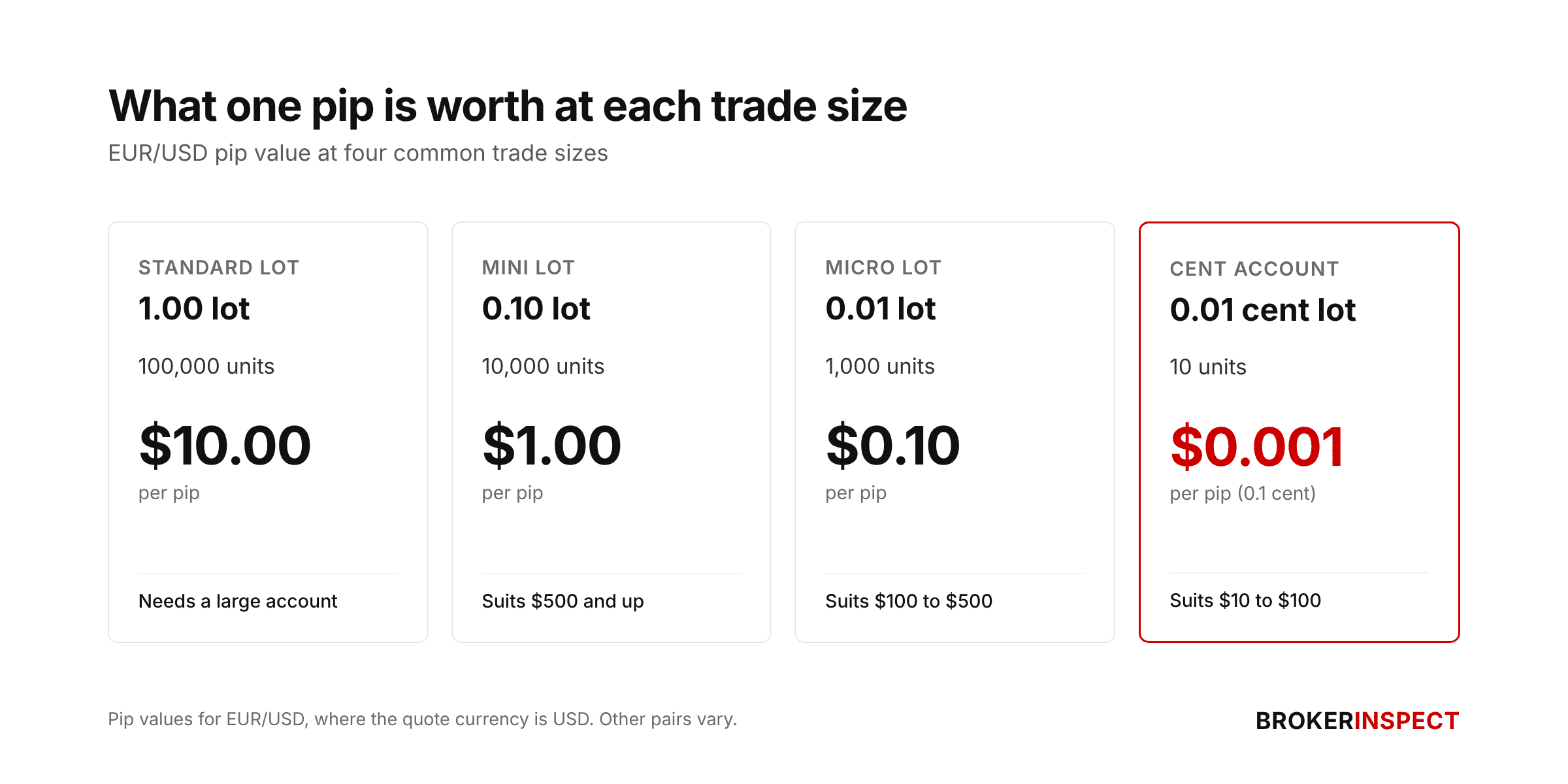
Cent accounts suit traders who want to test a strategy with real money and real emotions while keeping losses tiny. Once your balance and confidence grow, move to a standard account with micro lots. Our pip value calculator shows the exact pip value for any pair and trade size.
How Much Money Do You Need to Start Forex Trading?
Many traders aim to risk no more than 1% of their account on each trade. Here is what that rule means at three account sizes when you trade one micro lot on EUR/USD:
| Account size | 1% risk per trade | Stop-loss room with one micro lot | What works |
| $10 | $0.10 | 1 pip | Cent account only |
| $100 | $1 | 10 pips | Micro lots with tight stops |
| $500 | $5 | 50 pips | Micro lots with normal stops |
Leverage adds a second limit. At an EUR/USD rate of around 1.10, a micro lot is worth about $1,100. Under the 30:1 cap that ESMA, the FCA, and ASIC set for major pairs, it needs about $37 of margin, more than a $10 account holds. Offshore entities allow 1:500 or more, which lowers the margin but also makes it easier to lose your whole balance on one move.
For most people, $100 to $500 is a more realistic start on a standard account, while $10 to $50 fits a cent account. Our position size calculator works out the right trade size for your balance and stop-loss.
Risks of Low-Deposit Forex Brokers
A low minimum deposit is a marketing tool as much as a feature. Low deposit forex brokers share a few common risks:
- Offshore regulation: the lowest minimums often come through entities in places such as Belize, the Seychelles, or the BVI, where client protection is weaker.
- Very high leverage: ratios of 1:1000 or more can wipe out a small balance in one move.
- Bonus conditions: deposit bonuses often lock your funds until you trade a set volume.
- Withdrawal costs: fixed withdrawal fees take a large share of a small balance.
- Negative balance protection: check that the broker offers it for your entity, so you can’t lose more than you deposit. Our list of forex brokers with negative balance protection can help.
The risk is not only theoretical. When the European Securities and Markets Authority restricted CFDs in 2018, it noted that “74-89% of retail accounts typically lose money on their investments.” Australia followed with its own leverage limits in 2021.
“Protecting retail investors from harm, particularly at a time of heightened vulnerability, is a priority for ASIC.”
Cathie Armour, Commissioner, Australian Securities and Investments Commission, on ASIC’s CFD leverage limits (March 2021)
Before you deposit, check the broker’s licence on the regulator’s own register, such as the FCA Financial Services Register. The FCA warns that clients of unauthorised firms can’t use the Financial Ombudsman Service or the Financial Services Compensation Scheme if something goes wrong. If protection matters most to you, start with our list of the best regulated forex brokers.
Conclusion
You can start forex trading with $0 to $10 at all six brokers on this list, but they are not equal. Pepperstone and OANDA offer a $0 minimum under top-tier regulation. XM, Exness, and IUX open the door from $5 to $10, mostly through offshore entities. InstaForex goes as low as $1, with the weakest protection of the group.
If you only have $10, a cent account is the safest way to learn with real money. If you can start with $100 or more, a regulated broker with micro lots gives you better protection and more room to manage risk. For more options among the best forex brokers for small accounts, compare our best brokers for beginners.
FAQs
Which forex broker has the lowest minimum deposit?
InstaForex accepts deposits from $1, depending on the payment method. Pepperstone and OANDA go further with a $0 account minimum, though Pepperstone asks for at least $10 per top-up.
Can I trade forex with $1?
You can open an account with $1 at some brokers, but you can’t manage risk properly on that balance. Even on a cent account, $1 leaves little room for normal market moves.
Which forex brokers offer a $10 minimum deposit?
Exness and IUX both start at $10 on their Standard accounts, and Exness also offers a Standard Cent account from $10. The final figure can vary with your payment method.
Are forex brokers without a minimum deposit safe?
A $0 minimum says nothing about safety on its own. Pepperstone and OANDA are well regulated, but always check which entity and regulator would hold your account.
Do low minimum deposit brokers charge higher fees?
Not always, but some make up for the low entry point with wider spreads or withdrawal fees. Compare the spread on a 0.01-lot trade and the withdrawal cost before you sign up.
Is $100 enough to start forex trading?
Yes, for learning. With $100, you can trade micro lots and still keep each trade’s risk near $1, as long as you use a stop-loss and modest leverage.
About Author