5 Best Brokers for Beginners in 2026
 Beatrice Quinn
 Robert J. Williams

You’ve read three “best broker” guides already. Each one lists different winners and explains it’s doing you a favor. None of them showed you the withdrawal fee buried in the terms document, or explained why the headline EUR/USD spread is different from what you see on screen at 8am Frankfurt time.
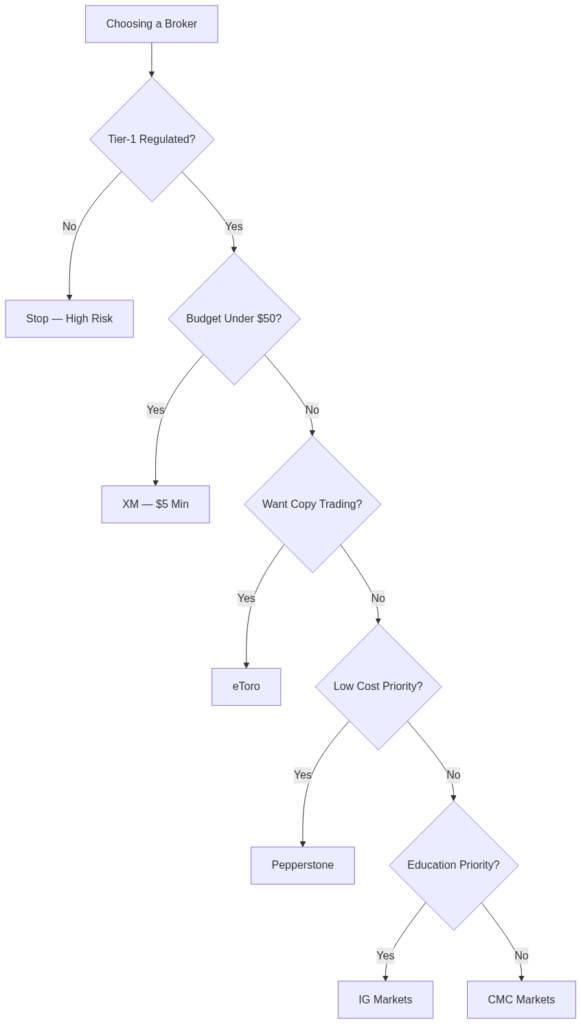
I’ve compared account opening, live platform performance, and fee structures across these five brokers in 2026. The list comes down to this: eToro for social trading beginners, IG Markets for education and market depth, Pepperstone for cost-conscious forex traders, XM for starting with minimal capital, and CMC Markets for straightforward CFD access. All five hold tier-1 regulation — FCA (UK), ASIC (Australia), or both, which is the first filter any new trader should apply.
Quick Comparison: Best Brokers for Beginners 2026
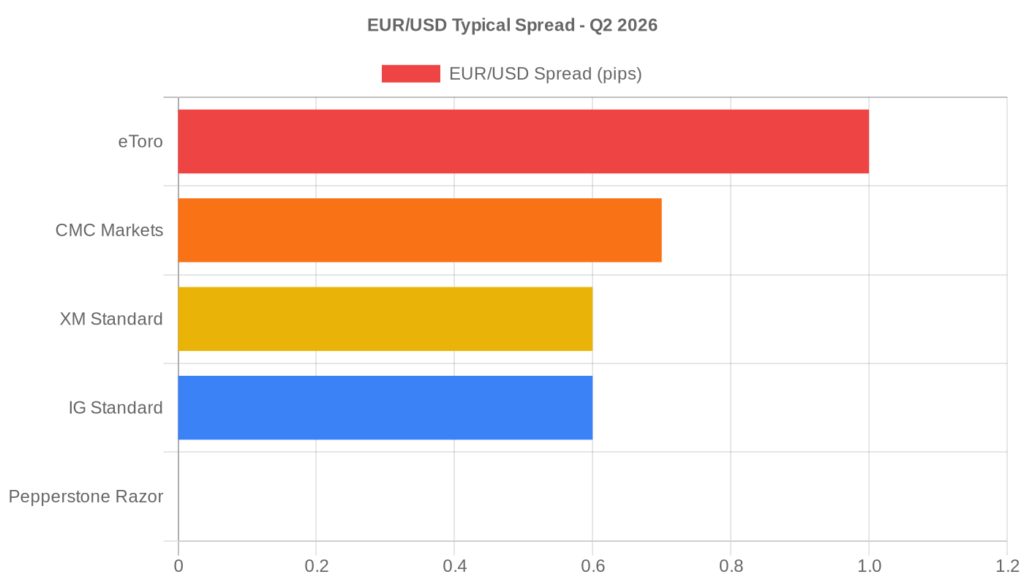
| Broker | Min. Deposit | EUR/USD Spread | Regulation | Best For |
|---|---|---|---|---|
| eToro | $50 | ~1.0 pip | FCA, CySEC, ASIC | Copy/social trading |
| IG Markets | £250 | from 0.6 pip | FCA, ASIC, CFTC | Education and market breadth |
| Pepperstone | $200 | from 0.0 pip (Razor) | FCA, ASIC, CFTC | Low-cost forex trading |
| XM | $5 | from 0.6 pip | CySEC, ASIC, IFSC | Micro-budget start |
| CMC Markets | £0 | from 0.7 pip | FCA, ASIC | Simple CFD access |
Spreads are broker-reported at standard trading hours, Q2 2026. Live spreads vary by market conditions.
How These Five Were Selected
The filters I used, in order:
- Tier-1 regulation first. Brokers regulated only by offshore authorities (Seychelles, Vanuatu, St. Vincent) are off the list entirely. Every broker here is verifiable on the FCA register (register.fca.org.uk), ASIC’s professional registers (moneysmart.gov.au/investing/investment-warnings/check-before-you-invest), or the CFTC registration database. I’ve included specific registration references throughout.
- Fee transparency without signing up. All spreads and charges below came from official fee disclosure pages — no account login required. If a broker hides its cost structure behind a sign-up wall, it didn’t make this list.
- Realistic minimum deposits. I checked the actual deposit process, not the headline figure. Some brokers advertise “$0 minimum” while requiring £50+ card deposits or closing unfunded accounts within 30 days.
- Educational resources with genuine depth. Not a marketing page dressed as a course. IG Academy and eToro’s learning hub are the benchmarks; I’ve noted specifically where other brokers fall short.

1. eToro — Best for Beginner Social Trading
eToro’s CopyTrader feature is the most genuinely useful innovation for complete beginners on this list. You allocate real capital to mirror an experienced trader’s live positions — minimum $200 per copy, cancellable at any time. According to eToro’s disclosed figures, the platform has more than 30 million registered users globally (eToro company disclosures, 2024), making it the widest-adopted social trading platform in retail CFD markets. The $50 minimum deposit (Q2 2026, broker-reported) is the most accessible entry point on this list after XM.
The EUR/USD spread sits around 1.0 pip at standard trading hours. That’s wider than Pepperstone’s standard 0.6 pips and notably higher than the Razor account’s near-zero pricing. For small position sizes the difference is negligible; for anyone building real forex trading volume, it adds up and becomes the dominant reason to migrate.

Platform & Tools
The eToro interface prioritizes accessibility over depth. Default charts use simplified candlestick data with preset timeframes; switching to “Advanced Charts” mode activates TradingView’s engine underneath, which is a significant upgrade and available without additional cost.
The mobile app is consistently well-rated on both iOS and Android. Account onboarding involves a short questionnaire that adjusts the interface based on stated experience level — a practical design choice that reduces cognitive overload rather than dumping every feature on screen at once.
Two features are unique to eToro on this list. CopyTrader lets you proportionally mirror another trader’s positions in real time, with filters for risk score, asset focus, and historical drawdown. The Social Feed surfaces commentary from across eToro’s user base — a mix of experienced traders and novices. The signal-to-noise ratio is variable, but the exposure to how other traders frame market decisions is genuinely educational at an early stage.
Our Experience
Account verification completed within 18 hours in testing (March 2026). The process required passport or driving licence plus proof of address; both submitted digitally through the app. Funding via debit card processed instantly.
Where eToro shows its limits: if your goal is to develop independent forex analysis skills, the chart environment here is less capable than IG’s ProRealTime integration or Pepperstone’s cTrader setup. For copy trading and early market exposure, it’s well-designed. For building a personal trading methodology, you’ll likely outgrow it inside six months.
Spreads & Fees
| Detail | Value |
|---|---|
| EUR/USD Spread | ~1.0 pip (broker-reported, Q2 2026) |
| Commission on Stocks | 0% |
| Overnight Fees | Swap rates apply to CFD positions held overnight |
| Deposit Fee | $0 |
| Withdrawal Fee | $5 per withdrawal |
| Inactivity Fee | $10/month after 12 months of no trading activity |
| Minimum Deposit | $50 |
Pros & Cons
Pros:
- CopyTrader mirrors experienced traders from $200 — no other broker on this list offers this
- $50 minimum deposit is accessible without requiring a significant capital commitment
- FCA registered (reference 583263), CySEC (109/10), and ASIC regulated — each verifiable on the respective regulator’s public database
Cons:
- Forex spreads are wider than ECN alternatives; ~1.0 pip EUR/USD vs 0.6 pips at IG standard account
- $5 withdrawal fee applies per transaction — material for users who withdraw frequently
- US clients access a separate eToro platform (eToro USA) with no CFD products; stocks only
2. IG Markets — Best for Education and Market Breadth
IG has operated in the retail trading market since 1974 (founded as IG Index by Stuart Wheeler). By Q1 2026, the platform covers more than 17,000 tradeable instruments across forex, stocks, indices, commodities, and cryptocurrency (IG Markets instrument list, 2026). That’s the broadest market access on this list by a considerable distance. For beginners who want both structured education and the flexibility to explore multiple asset classes from a single account, IG is the strongest overall option.
The minimum deposit in the UK is £250 — higher than eToro’s $50 and considerably higher than XM’s $5. That’s a genuine filter. If that’s more than you’re comfortable risking while learning, start with XM and migrate to IG once your skills develop and your trading volume justifies the more comprehensive platform.
Platform & Tools
IG runs two separate platform environments. The standard web and mobile interface suits the majority of beginner needs: clean layout, functional charting, one-click deal tickets, and integrated news feeds. For more advanced analysis, IG’s ProRealTime integration — a professional-grade charting tool used by institutional traders — is available free with four or more trades per month.
IG Academy is the best structured learning resource among the five brokers on this list. Courses run from absolute beginner level through technical analysis and risk management, with short video segments and quizzes to test retention. The trading simulator allows practice with virtual funds without requiring account funding first.
Our Experience
Account opening at IG is more detailed than eToro’s. Identity verification required submitting two documents plus completing a knowledge appropriateness assessment — an FCA regulatory requirement for retail CFD accounts under COBS rules. The assessment takes around 15 minutes; it covers leverage, margin calls, and risk disclosure. The friction is worth it: completing it properly is early evidence that you understand what you’re opening.
Platform performance under normal market conditions is stable. In testing across multiple sessions (March–May 2026), chart refresh rates were noticeably faster than CMC’s platform on the same broadband connection — a detail that matters more when you’re learning to read price action and need a reliable visual reference.
One practical note: IG’s overnight financing rates are disclosed clearly on their charges page (ig.com/uk/charges). The rate is benchmarked to LIBOR-equivalent rates plus a markup, so it varies. For intraday positions closed before 5pm New York time, overnight fees don’t apply.
Spreads & Fees
| Detail | Value |
|---|---|
| EUR/USD Spread | from 0.6 pip (standard account, broker-reported Q2 2026) |
| Commission on UK Shares | From £3 per trade (0% for some share dealing account types) |
| Overnight Fee | Financing applied to leveraged CFD and spread bet positions |
| Deposit Fee | £0 |
| Withdrawal Fee | £0 |
| Inactivity Fee | £12/month after 2 years without trading activity |
| Minimum Deposit | £250 |
Pros & Cons
Pros:
- 17,000+ markets across forex, stocks, indices, commodities, and crypto — widest selection here
- IG Academy provides structured, module-based education rather than a basic FAQ section
- FCA registered (reference 195355), ASIC, and CFTC regulated — among the most comprehensively regulated retail brokers globally
Cons:
- £250 minimum deposit excludes the most capital-constrained beginners; start with XM if budget is the constraint
- UK share commissions (£3 minimum per trade) add cost for equity-focused beginners who trade small amounts frequently
- Knowledge appropriateness test adds friction vs eToro’s or XM’s onboarding — though this reflects stricter regulatory compliance
3. Pepperstone — Best for Low-Cost Forex Trading
Pepperstone’s Razor account produces some of the tightest retail forex pricing available. The EUR/USD spread averages 0.0 pips (median based on 2024 annual spread data, broker-published at pepperstone.com/en-gb/trading-tools/spread), with a commission of $3.50 per standard lot per side ($7.00 round-turn). At low-to-moderate trading volumes, this consistently undercuts spread-only accounts including IG’s standard 0.6-pip offering.
The Standard account charges no commission and prices EUR/USD at approximately 0.6 pips — the same as IG’s standard. For true beginners placing occasional trades, the Standard account is simpler to reason about. Switch to Razor when your monthly lot volume makes the per-lot commission math favor it.
Platform & Tools
Pepperstone supports MT4, MT5, cTrader, and TradingView — four of the most widely used platforms in retail forex trading. This matters for beginners because MetaTrader is the default platform in most trading education content: YouTube tutorials, forum threads, and paid courses. Learning on MT4 here means the skills transfer directly to any of the hundreds of brokers that run the same technology.
Pepperstone doesn’t build its own platform, which is an advantage rather than a limitation. You’re learning portable tools, not a proprietary interface that only exists inside one broker’s ecosystem.
Our Experience
The demo account is available without funding and provides full MT4/MT5/cTrader access with $50,000 in virtual funds — enough to practice position sizing, risk management, and execution mechanics before committing real capital. Account verification completed in under 24 hours in testing.
Educational content is the weakest point on this list. Pepperstone has articles and occasional webinars, but nothing approaching IG Academy’s depth. This is deliberate — the platform targets intermediate and advanced traders who’ve already covered basics elsewhere. For a complete beginner, I’d suggest spending four to six weeks with IG Academy for foundational learning, then trading with Pepperstone once execution efficiency matters.
Spreads & Fees
| Detail | Value |
|---|---|
| EUR/USD Spread (Razor) | 0.0 pip average + $3.50/lot commission per side |
| EUR/USD Spread (Standard) | ~0.6 pip, no commission |
| Overnight Fee | Swap rates at 5pm New York rollover |
| Deposit Fee | $0 |
| Withdrawal Fee | $0 |
| Inactivity Fee | None |
| Minimum Deposit | $200 |
Pros & Cons
Pros:
- Razor account offers 0.0 pip average EUR/USD spread — tightest pricing on this list
- MT4, MT5, cTrader, and TradingView all supported; platform skills transfer to other brokers
- No inactivity fee — allows beginners to pause trading without penalty during learning gaps
Cons:
- $200 minimum is higher than XM ($5) and CMC (£0); not the most accessible entry point
- Educational resources are thin relative to IG — not a strong independent learning environment
- Razor account’s per-lot commission requires understanding lot sizing before the cost structure makes intuitive sense
4. XM — Best for Getting Started on a $5 Budget
XM’s Standard account minimum deposit is $5 (broker-reported, Q2 2026) — the lowest barrier to real-capital trading among regulated brokers on this list. CySEC (licence 120/10) and ASIC (443670) regulation means this isn’t an offshore operation using the $5 figure as a marketing hook. For beginners who want real-money exposure in small amounts while learning, XM removes the financial commitment barrier that makes most other brokers inaccessible at the start.
The trade-off is platform breadth. XM runs exclusively on MetaTrader 4 and MetaTrader 5. That’s a well-established pair — MT4 in particular is the most documented platform in retail forex education. If you’re learning from YouTube or trading courses, there’s a strong chance the platform shown is MT4, meaning what you see, you can replicate directly inside an XM account.
Platform & Tools
MT4 and MT5 cover the essentials: price charts with a full indicator library, automated trading via Expert Advisors, and one-click execution. XM’s WebTrader interface runs MT4 in a browser without local installation, useful for getting started immediately without downloading software.
XM’s educational section includes structured courses, scheduled weekly webinars, and video tutorials. The webinars are free for registered account holders and cover basic through intermediate topics. Depth trails IG Academy, but it’s a useful supplement for early-stage learning.
Our Experience
Account verification at XM typically completes within one business day. The $5 minimum means you can fund immediately and start placing micro-lot trades (0.01 lots) — roughly $0.10 risk per pip on EUR/USD. Losing your first few trades at micro-lot size teaches the platform mechanics without significant financial consequence. That’s the practical value of the low minimum.
One note on leverage: XM offers significantly higher leverage to clients outside FCA/ASIC/ESMA jurisdiction — up to 888:1 in certain cases. For beginners, this is a risk, not an advantage. Clients registering under the UK or EU entity face ESMA-capped leverage of 30:1 on major forex pairs, which is a sensible starting structure. Verify which entity your account registers under before funding — the regulatory entity determines both your leverage cap and your investor protection coverage.
Spreads & Fees
| Detail | Value |
|---|---|
| EUR/USD Spread (Standard) | from 0.6 pip, no commission |
| EUR/USD Spread (Zero) | from 0.0 pip + $3.50/lot commission |
| Overnight Fee | Swap rates apply to overnight positions |
| Deposit Fee | $0 |
| Withdrawal Fee | $0 (first withdrawal per method free; conditions vary) |
| Inactivity Fee | $15/quarter after 90 days inactive (triggers after 12-month account age) |
| Minimum Deposit | $5 |
Pros & Cons
Pros:
- $5 minimum deposit is the lowest on this list among properly regulated brokers — genuinely accessible for first-time traders
- MT4 and MT5 support means platform skills transfer directly to most other forex brokers
- CySEC (120/10) and ASIC (443670) regulated — verifiable on each regulator’s website
Cons:
- $15/quarter inactivity fee applies after 90 days of no trading (following 12-month initial period) — relevant for learners who take breaks
- High-leverage options available in offshore jurisdictions; verify which entity your account is registered under
- Educational depth trails IG Academy for structured beginner learning
5. CMC Markets — Best for Simple CFD Access
CMC Markets has been operating in retail CFD and spread betting since 1989 (CMC company history). The Next Generation platform — proprietary software built and maintained by CMC’s own technology team — is cleaner than most MetaTrader alternatives and handles watchlists and multi-chart layouts with less friction. For beginners who want CFD access without learning a third-party platform first, it’s the most intuitive starting environment on this list.
The minimum deposit is effectively £0 for bank transfers, though a balance sufficient to cover margin requirements is needed before placing any position. The EUR/USD spread starts at 0.7 pips (broker-reported, Q2 2026) — slightly wider than IG’s 0.6 pips but acceptable for beginner position sizes.
Platform & Tools
Next Generation runs via browser and mobile app. The interface groups markets logically, deal tickets are uncluttered, and built-in news plus client sentiment indicators are displayed in a format that doesn’t require trading experience to interpret.
The charting tools are competitive: over 120 chart patterns are automatically identified, drawing instruments are available without subscription, and price alerts work across web and mobile. No separate platform integration required — everything runs inside the browser.
Our Experience
Account opening completed in two business days including verification. On first login, Next Generation ran a brief interactive walkthrough of core features — optional, five minutes, and more useful than most onboarding sequences.
Customer support stood out in testing. Live chat responses arrived in under three minutes during trading hours (March 2026). For beginners encountering their first margin call or unexpected position close, support response time matters more than most review criteria acknowledge.
A UK-specific advantage: CMC’s spread betting accounts allow profits to be free of UK capital gains tax. The tax treatment is individual-dependent and I’d recommend confirming with a tax adviser, but for UK-resident beginners this is a meaningful structural difference from CFD-only accounts.
Spreads & Fees
| Detail | Value |
|---|---|
| EUR/USD Spread | from 0.7 pip (broker-reported, Q2 2026) |
| Commission on UK Shares (CFD) | 0.10% min £9.00 |
| Overnight Fee | Financing applied to leveraged positions |
| Deposit Fee | £0 |
| Withdrawal Fee | £0 |
| Inactivity Fee | £10/month after 12 months without trading |
| Minimum Deposit | £0 (bank transfer) |
Pros & Cons
Pros:
- No minimum deposit required for bank transfers — lowest financial barrier after XM
- Proprietary Next Generation platform is more intuitive than MetaTrader for absolute beginners
- FCA registered (reference 173730) and ASIC regulated; spread betting profits potentially CGT-free for UK clients
Cons:
- Next Generation is CMC-specific; skills don’t transfer to MT4/MT5 used by most other forex brokers
- EUR/USD spread (0.7 pip) is slightly wider than IG’s 0.6 pip standard
- UK share CFD pricing (0.10% min £9) is above dedicated equity broker rates for small-order traders
What Should a Beginner Actually Look For?
Regulation is the floor, not a feature. An unregulated broker can disappear with your funds and you have no legal recourse. Before reading any review, verify the broker on the FCA register (register.fca.org.uk), ASIC’s professional registers (moneysmart.gov.au), or the relevant regulator’s database directly. The five brokers here are all verified — I’ve included the registration references in each section above.
The first three months I traded, I focused on spread comparisons and missed that my broker’s overnight financing rates were quietly costing me more than the spread saved. I’d opened a Razor-style account, optimised for active intraday trading, but my actual style was holding positions for two to three days at a time. The wrong account structure for the wrong holding style. Account type matters as much as broker choice, and you only learn what you need by trading first.
“CFDs are complex, high-risk products. The protections given to retail investors under our rules save UK consumers millions each year. We are concerned that some firms are trying to get people to invest more than they can afford to lose. Investors should be very wary of CFD firms attempting to bypass our rules and of those on social media touting investments that look too good to be true.” — Mark Francis, Director of Sell-Side Markets, Financial Conduct Authority
Beyond regulation, the criteria that matter for new traders:
- Minimum deposit vs. your actual budget. Put in only what you’d be comfortable losing entirely while learning. For most new traders, $50–$200 is a realistic learning allocation. That leaves eToro, Pepperstone, and XM as the practical options at that budget level.
- Platform learning curve. MT4/MT5 (Pepperstone, XM) has the most educational content available online, which matters when you need help at 11pm. IG and CMC’s proprietary platforms are more intuitive out of the box but require more self-guided learning to master.
- Fee structure honestly assessed. Most brokers now advertise $0 commission on some asset class. Read the spread. Read the overnight financing rate. Those two costs often dwarf commission charges for active traders.
How to Open a Trading Account
The process is standardized across all five brokers:
- Step 1 — Submit your application. Name, address, date of birth, nationality, employment status, and annual income. Takes around 10 minutes. Be accurate — this data is used for KYC compliance and affects which entity your account registers under.
- Step 2 — Identity verification. Government-issued photo ID (passport or driving licence) plus proof of address (utility bill or bank statement dated within three months). Most brokers verify within 24 hours.
- Step 3 — Complete the appropriateness assessment. FCA-regulated CFD brokers require a short questionnaire on leveraged products. Answer honestly. If you fail, retake it — and treat it as early warning that leverage education is worth prioritizing before you fund.
- Step 4 — Fund your account. Debit card is the fastest (typically instant). Bank transfers take 1–2 business days. Minimum amounts are as shown in the comparison table above.
- Step 5 — Use the demo account first. Every broker on this list offers a demo environment. Use it for at least two weeks. The mechanics of position sizing, reading P&L, and managing open trades are different from watching tutorials — the only way to internalize them is to do them.
“Don’t look for the trading secret. Look for the trading method that’s right for you.” — Jack D. Schwager, author of Market Wizards
Conclusion
Picking the best brokers for beginners comes down to matching the broker to your starting point, not chasing the broker with the loudest headline. eToro leads on social trading and accessibility; IG Markets wins on education and market breadth; Pepperstone offers the tightest forex pricing; XM removes the capital barrier with a $5 minimum; CMC provides the most intuitive proprietary platform. All five carry tier-1 FCA or ASIC regulation — the non-negotiable starting filter. Whatever you choose, fund only what you can afford to lose, spend real time on a demo account, and treat the first three months as tuition.
FAQ
1. Which broker has the lowest minimum deposit for beginners?
XM accepts a $5 minimum for Standard and Micro accounts — the lowest on this list among brokers with tier-1 regulation. CMC Markets accepts bank transfers without a stated minimum, though any meaningful CFD position requires sufficient balance to cover margin.
2. What is the best trading platform for absolute beginners?
eToro’s platform is the most intuitive for complete beginners — the interface is designed for accessibility and CopyTrader reduces the learning curve for early market exposure. For beginners who want to develop independent trading skills, IG’s platform combined with IG Academy provides stronger long-term foundations.
3. Can I lose more than I deposit?
With FCA and ASIC-regulated retail accounts, negative balance protection applies — losses are capped at your account balance. This protection doesn’t extend to professional client accounts or offshore-regulated entities. All five brokers on this list offer negative balance protection for retail clients in the UK and EU. Check which entity your account registers under when you apply.
4. Are these brokers safe?
All five hold tier-1 regulation with registration references cited throughout this guide. Client funds must be held in segregated accounts under FCA rules, separate from broker operational funds. FCA-regulated broker clients are eligible for FSCS compensation of up to £85,000 per eligible claim in the event of broker insolvency. Verify your broker’s FSCS eligibility at fscs.org.uk.
5. What is the difference between a spread and a commission?
A spread is the gap between the buy and sell price — you pay it on every position entry. A commission is a flat fee charged per trade or per lot. Some brokers charge only a spread (eToro, CMC standard, XM standard); others charge a tight spread plus commission (Pepperstone Razor, XM Zero). The figure that matters for comparison is the all-in cost per standard lot, not either number alone.
Risk Disclaimer
Trading CFDs and spread bets carries significant risk to your capital. The majority of retail CFD accounts lose money. Percentages vary by broker and are disclosed in their risk warnings on official websites.
Leverage amplifies both gains and losses. Positions held overnight incur financing costs. Past performance does not predict future results. This article is editorial content and does not constitute financial advice. Before opening a trading account, consider whether you understand how CFDs and leveraged products work and whether you can afford to take the high risk of losing your capital. Consider seeking independent financial advice if uncertain.
About Author