
Best Forex Brokers in India for Beginners
 Beatrice Quinn
 Robert J. Williams
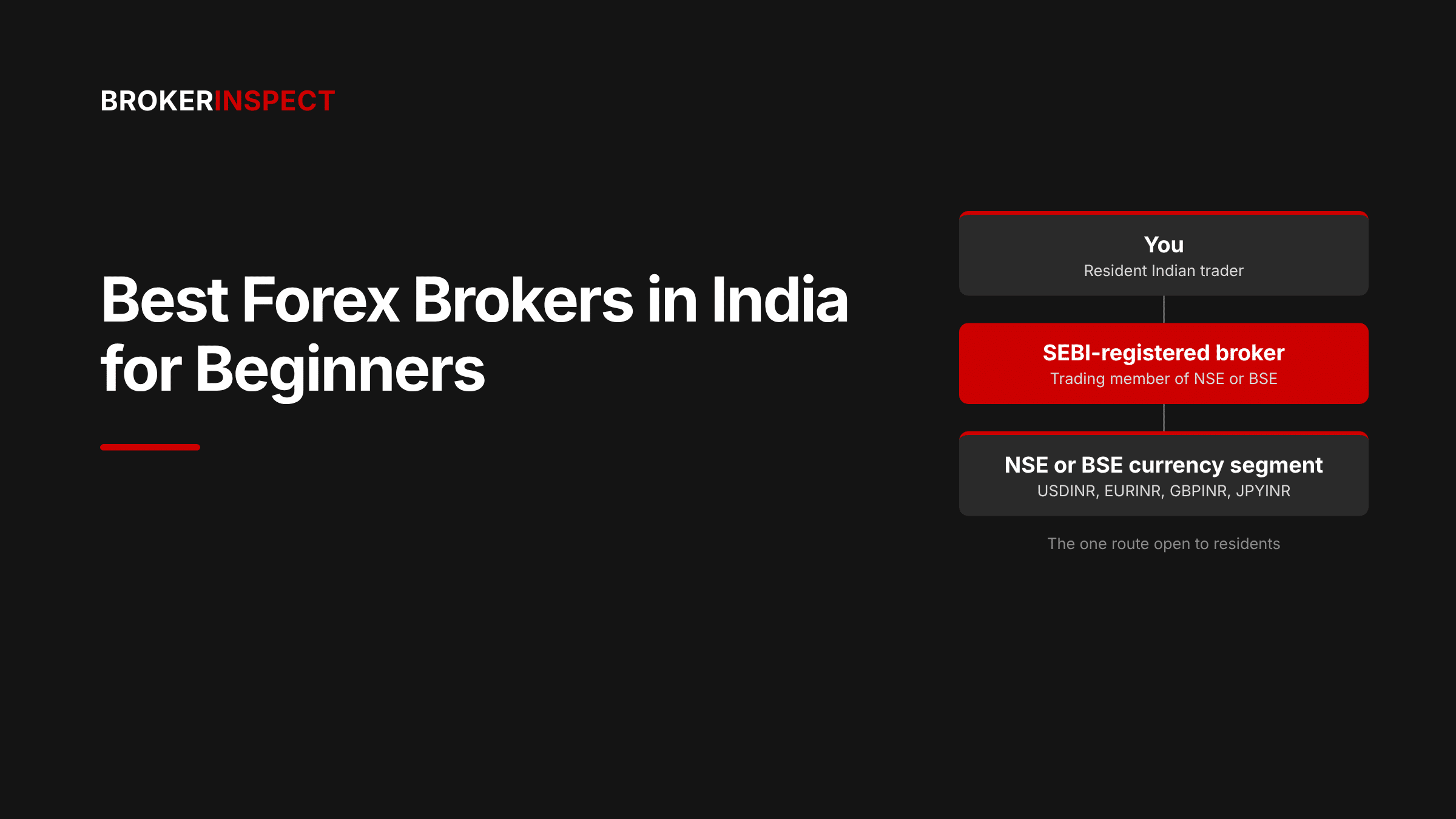
The best forex brokers in India for beginners are SEBI-registered brokers that give you access to the NSE or BSE currency segment. They are the only brokers an Indian resident can use legally, because offshore forex brokers are not allowed to deal with residents.
This guide explains what the law lets you trade, compares four SEBI-registered brokers on facts you can verify, and walks you through the checks before you open an account.
Key Takeaways
- Residents may trade only rupee pairs (USDINR, EURINR, GBPINR, JPYINR) on NSE or BSE, through a SEBI-registered broker.
- Offshore brokers, EUR/USD and gold CFDs are outside the law for residents, and sending money abroad for forex margin is barred.
- Zerodha, Angel One, 5paisa and Upstox all publish brokerage of about ₹20 per order for currency trades.
- Verify the SEBI registration number before you deposit anything.
Best Forex Brokers in India for Beginners: At a Glance
We read each broker’s SEBI registration number and currency brokerage from its own disclosure and pricing pages in October 2026.
| Broker | SEBI registration | Currency futures | Currency options |
| Zerodha | INZ000031633 | 0.03% or ₹20, whichever is lower | Flat ₹20 per order |
| Angel One | INZ000161534 | ₹20 per order after a 30-day offer | ₹20 per order after a 30-day offer |
| 5paisa | INZ000010231 | ₹20 per order | ₹20 per order |
| Upstox | INZ000315837 | Up to ₹20 per order | Up to ₹20 per order |
Brokerage is only part of your cost. Exchange charges, GST, and stamp duty apply on top, so use each broker’s calculator on a sample trade.
Can Indian Beginners Trade Forex Legally?
Yes, but within tight limits. The Foreign Exchange Management Act, 1999 governs forex dealing in India. RBI has said residents can undertake forex transactions only with authorised persons and for permitted purposes, and only on RBI-authorised platforms or on recognised exchanges: NSE, BSE and the Metropolitan Stock Exchange (RBI, Alert List press release).
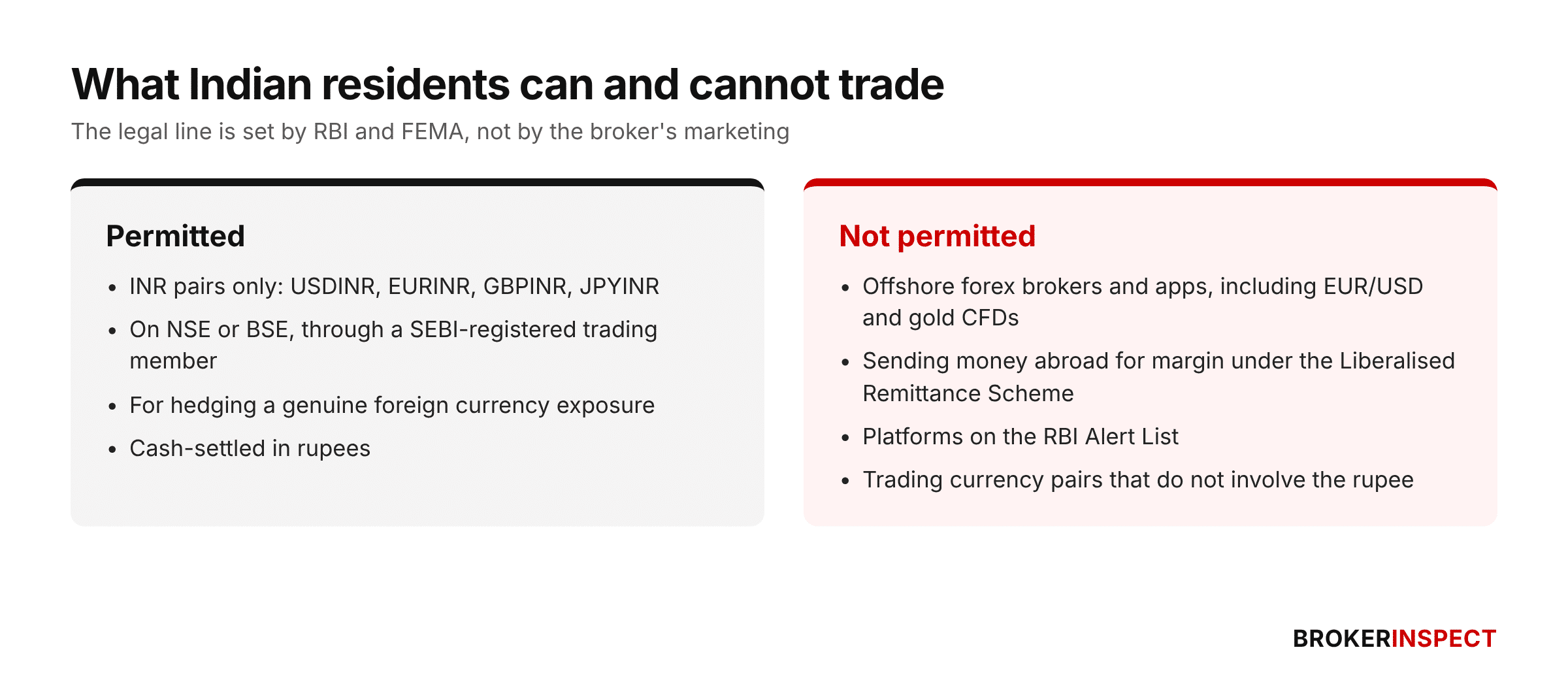
What the rules allow
You can trade currency futures and options on four rupee pairs: USDINR, EURINR, GBPINR and JPYINR. Contracts are cash-settled in rupees, and exchange hours run from 9:00 a.m. to 5:00 p.m., Monday to Friday (NSE contract specifications).
RBI’s policy is that these contracts are permitted only for hedging, which means you need an underlying foreign currency exposure. Its 4 April 2024 press release confirmed the rule and set the effective date of its consolidated directions at 3 May 2024. Traders with a valid exposure can hold positions up to USD 100 million across exchanges without producing documents.
“Only for the purpose of hedging.”
RBI, on exchange-traded rupee currency derivatives, press release of 4 April 2024
What the rules rule out
Offshore forex brokers, EUR/USD, gold CFDs and any pair without the rupee are not open to residents. The Liberalised Remittance Scheme also prohibits remittances “for margins or margin calls to overseas exchanges” and for trading in foreign exchange abroad (RBI LRS FAQ). RBI keeps an Alert List of unauthorised platforms, and it warns that the list is not exhaustive, so absence from it is no proof of safety.
Best Forex Brokers in India for Beginners: Four SEBI-Registered Options
The brokers below are listed alphabetically. We have not ranked them, because the evidence does not support one winner for every beginner.
Zerodha
Zerodha publishes the clearest futures fee: 0.03% or ₹20 per executed order, whichever is lower, and a flat ₹20 for options. Its SEBI number is INZ000031633. Read our Zerodha review for the wider picture.
Angel One
Angel One advertises ₹0 brokerage, up to ₹500, for the first 30 days, then ₹20 per executed order on currency futures and options. Its SEBI number is INZ000161534. The offer helps if you want to test the platform at low cost, but the waiver ends once you use it.
5paisa
5paisa lists a flat ₹20 per executed order for both currency futures and options. When we checked, its homepage showed only a “SEBI Registered” badge. The number, INZ000010231, is on its mandatory documents page.
Upstox
Upstox states brokerage of up to ₹20 per order across stocks, F&O, commodity and currency trades, and its pricing page lists the currency segment. The SEBI number shown is INZ000315837, under Upstox Securities Pvt. Ltd. Confirm that currency derivatives are active on your account, since the pages we checked do not state it.
How to Choose a Forex Broker in India
Since all four brokers charge similar brokerage, the best forex broker in India for you is the one that passes the checks below:
- Registration: the name and INZ number must match SEBI’s records.
- Segment access: currency derivatives must be switched on for your account on NSE or BSE.
- Total cost: brokerage plus exchange charges and GST on a trade of your size.
- Margin clarity: the platform should show margin before you place the order.
- Support and learning: a clear app, contract notes, and educational resources you need.
How to verify a broker’s registration
Take the INZ number from the broker’s footer or disclosure page and look up the broker in SEBI’s intermediary directory. The same directory lists cancelled, surrendered and suspended intermediaries, so check there too. Avoid any broker that cannot show a number.
For wider comparisons, see our guide to the top stock brokers in India and the 7 best forex brokers for beginners.
How to Start Forex Trading in India
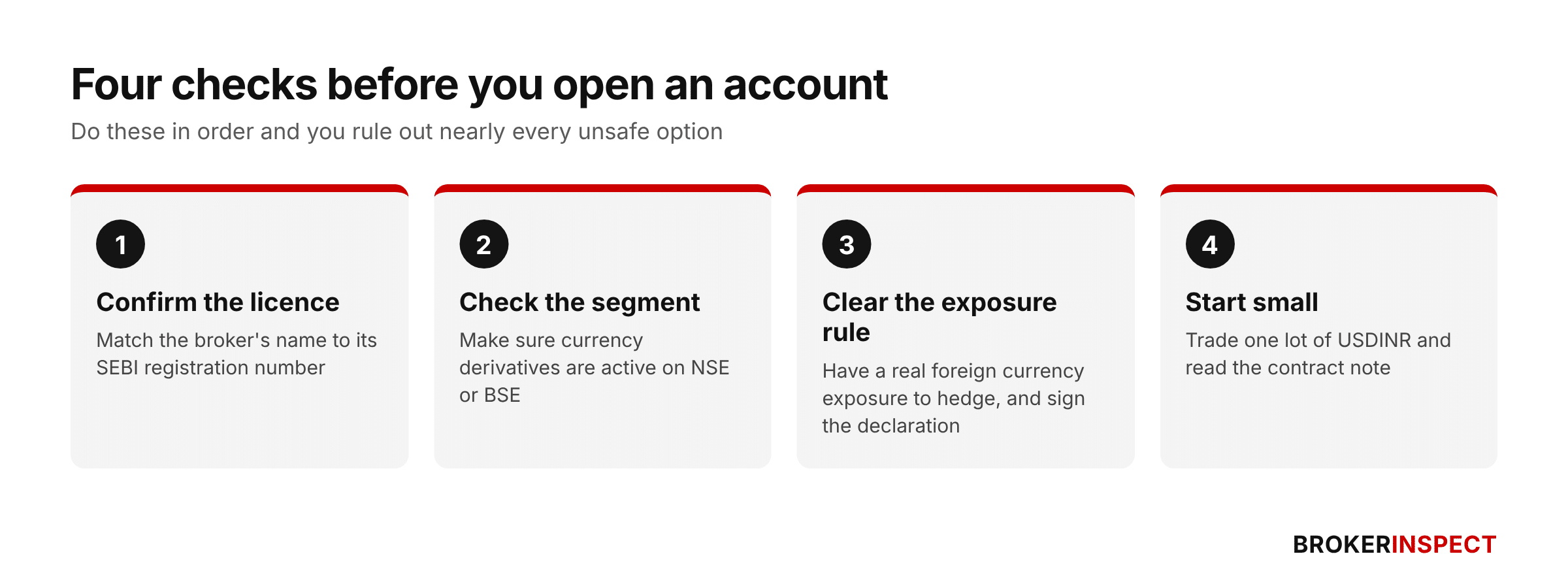
1. Confirm the licence: Match the broker’s name to its SEBI registration number.
2. Check the segment: Complete KYC and ask for currency derivatives to be activated on NSE or BSE.
3. Clear the exposure rule: Sign the declaration of your underlying foreign currency exposure.
4. Start small: Trade one lot of USDINR, read the contract note, and learn how margin changes daily.
A USDINR lot is 1,000 US dollars, and the minimum price move is ₹0.0025, which is worth ₹2.50 per lot. This makes the first trades small, but losses still add up, so set a limit in rupees before you begin.
Conclusion
The best forex brokers in India for beginners are the SEBI-registered ones that offer the NSE or BSE currency segment, because this is the only route the law opens to residents. Zerodha, Angel One, 5paisa and Upstox all qualify on published facts, and they price currency trades within a few rupees of each other. Choose on registration, segment access and total cost, confirm your underlying exposure, and begin with a single lot.
This article is general information, so speak to a SEBI-registered adviser before you commit money.
FAQs
Is forex trading legal in India?
Yes, but in a narrow form. Residents may trade rupee pairs such as USDINR, EURINR, GBPINR and JPYINR on NSE or BSE through a SEBI-registered broker, and only to hedge a real foreign currency exposure. Trading other pairs, or using offshore platforms, breaches the Foreign Exchange Management Act.
Which is the best forex broker in India for a beginner?
Among SEBI-registered brokers, Zerodha, Angel One, 5paisa, and Upstox all publish low currency brokerage. The best fit is the one that has the currency segment active for you, charges the least on your order size, and has a clear app. Check these three things before you fund the account.
Can I trade EUR/USD or gold CFDs from India?
Not legally. Indian residents may trade only pairs that include the rupee, on a recognised exchange. EUR/USD, gold CFDs and similar products come from offshore brokers, which are not authorised to deal with residents, and the Liberalised Remittance Scheme bars sending money abroad for forex margin.
How much money do I need to start?
No fixed minimum applies. One USDINR lot is 1,000 US dollars, and the margin you must hold is set by the exchange’s SPAN system and can change daily. Use your broker’s margin calculator for the exact figure, and begin with a single lot.
How do I check that a forex broker is SEBI registered?
Find the broker’s SEBI registration number, which starts with INZ for stock brokers, in its website footer or disclosure page. Then match it against SEBI’s recognised intermediaries list. Also confirm that the broker is not on SEBI’s lists of cancelled or suspended intermediaries.
Why does my broker ask for an underlying exposure?
RBI allows rupee currency derivatives only for hedging, so you must hold a real or expected foreign currency exposure, such as export receipts, import payments, or a foreign currency loan. Brokers collect a declaration to that effect. Traders with a valid exposure can hold positions up to the RBI limit without producing documents.
About Author