
Best CFD Brokers in India
 Beatrice Quinn
 Robert J. Williams
| Key Takeaways 1. All three brokers say in writing whose account they take money from and pay out to. 2. RBI’s Alert List names IC Markets and Pepperstone; RoboForex is absent. 3. A resident dealing with an unauthorised firm is liable for penal action under FEMA. 4. Find the company name in your client agreement, then check it against its regulator’s register. 5. The broker’s own fee is rarely the whole cost, because banks in between add their own. |
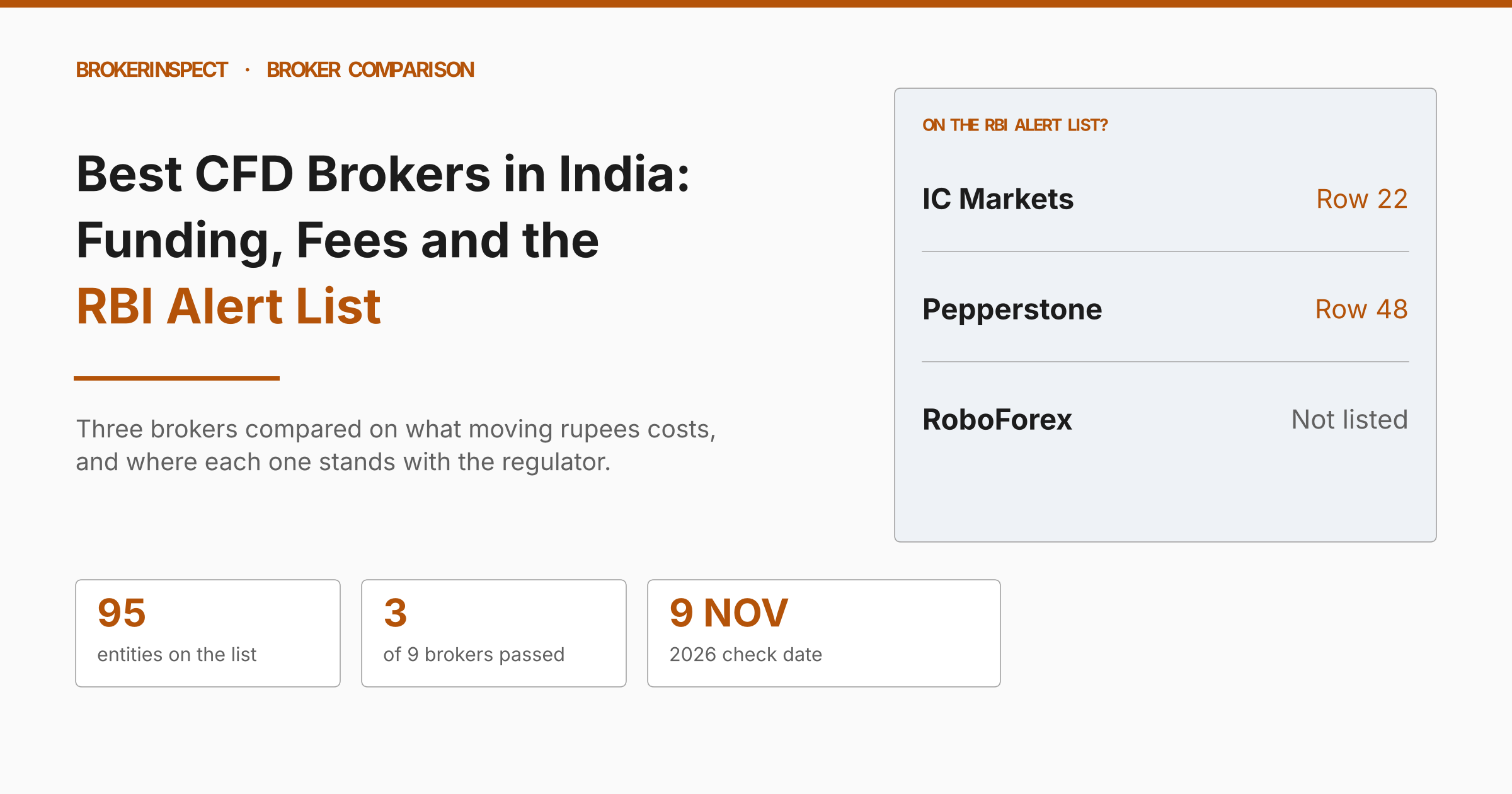
IC Markets, Pepperstone and RoboForex are the best CFD brokers in India to compare on getting money in and out. Each states plainly whose bank account it will take money from and pay money to. Two of the three are on the Reserve Bank of India’s Alert List.
Best CFD brokers in India: At a Glance
| BROKER | COMPANY AND REGULATOR (SITE-STATED) | ALERT LIST ROW (19 NOV 2025) | ACCOUNT IT PAYS TO OR TAKES FROM | WITHDRAWAL CHARGE |
|---|---|---|---|---|
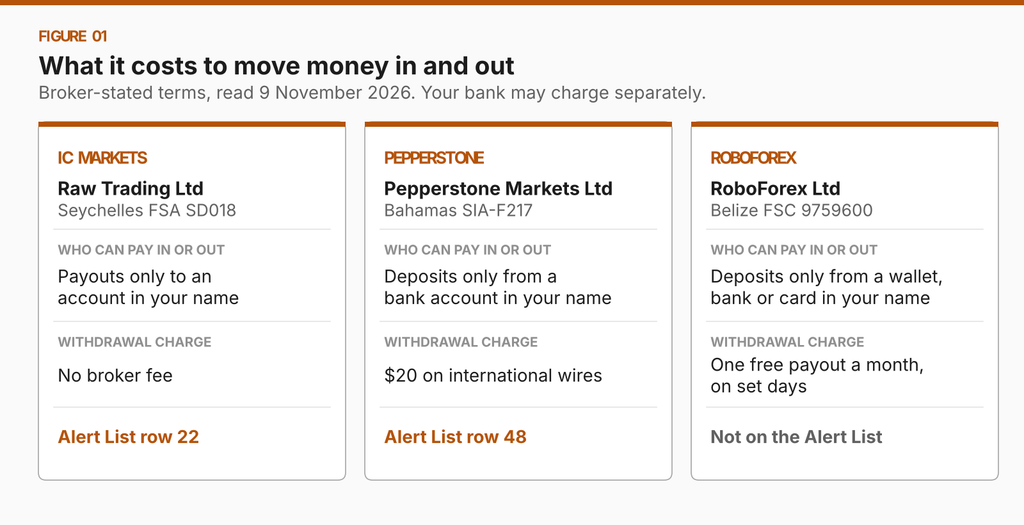
| IC Markets | Raw Trading Ltd, Seychelles FSA SD018 | Row 22 | Payouts to the holder’s own account | No broker fee; banks may charge |
| Pepperstone | Pepperstone Markets Limited, Bahamas SIA-F217 | Row 48 | Deposits from your own bank account | $20 on international wires |
| RoboForex | RoboForex Ltd, Belize FSC 9759600 | Not on the list, which is not approval | Deposits from your own wallet, bank, or card | One free payout a month, on set days |
Broker-stated terms, read 9 November 2026.
How we picked the top three
A broker reaches this shortlist only if its own pages answer three questions about money moving in and out. Spreads, platforms and bonuses count for nothing here.
- Company and regulator: The site names the legal entity you are contracting with, its regulator and its licence number.
- Payment-name rule: The site says whose bank account, card or wallet may send money in and receive it back. This is the rule that blocks a deposit from a spouse, a parent or a company account.
- Withdrawal cost: The site says what a withdrawal costs at the broker’s end, or when that charge is waived.
On 9 November 2026, we checked nine CFD brokers in India: IC Markets, FP Markets, FxPro, Vantage, Exness, XM, Pepperstone, RoboForex and Fusion Markets. Three answered all three questions on their own pages. Our other broker lists cover the rest.
What is the RBI Alert List, and does it matter?
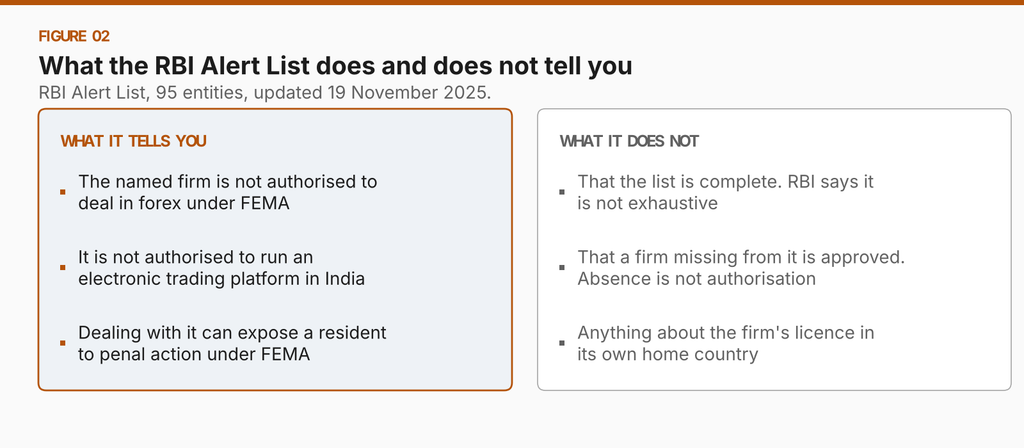
The Alert List is RBI’s register of firms not authorised under FEMA to deal in foreign exchange or run an electronic trading platform in India. The version updated on 19 November 2025 names 95 entities. IC Markets is at row 22 and Pepperstone at row 48.
However, RBI says the list is not exhaustive, so a firm can be unauthorised without appearing on it, and that an entity missing from it should not be assumed to be authorised. RoboForex’s absence therefore tells you nothing about its standing in India.
1. IC Markets: no withdrawal fee at the broker’s end
IC Markets adds no withdrawal fee of its own, and pays out only to an account in the holder’s name. Bank transfers take one to two business days at home and two to fourteen abroad once processed, and banks along the way may still charge you.
The firm you contract with is Raw Trading Ltd, trading as IC Markets. Its global site names the Seychelles Financial Services Authority as its regulator, under licence SD018.
Its Standard account page lists ten base currencies, the currency your balance is held in. The rupee is not among them, so a rupee deposit is converted on the way in and again on the way out.
The drawback: Leverage runs to 1:5000 on MetaTrader, and IC Markets calls it dynamic, which means the broker can change it at any time. Because leverage sets how much of your own money must sit behind a position as margin, a change can leave a trade short of margin without the price moving at all.
2. Pepperstone: no fee on deposits
Pepperstone charges no fee on deposits by any method, and charges $20 only when it sends a withdrawal abroad by international wire. Card issuers and banks in between can add their own charges too.
It doesn’t accept third-party payments, so the money has to come from a bank account in your own name.
The firm named on the site is Pepperstone Markets Limited, regulated by the Securities Commission of The Bahamas under SIA-F217. The regulator’s own list, as at 31 October 2026, shows the firm registered for trading CFDs, with its category and address.
The drawback: Pepperstone’s Bahamas terms allow a fee of up to 1% to move money between two of your own accounts when they are held in different currencies. Our Pepperstone review covers the rest.
3. RoboForex: published swaps and covered deposit costs
RoboForex refunds deposit fees. For example, if your card provider charges 0.8% on $1,000 deposit, RoboForex reimburses that amount. The firm is RoboForex Ltd, registered with Belize’s Financial Services Commission under licence 9759600.
It also publishes its overnight charges, which many brokers leave buried. A swap is the charge or credit for holding a trade overnight. As of November 2026, the Pro account’s gold contract card shows an 18.0-pip average spread, with a swap of -60 pips to hold a buy and +19 to hold a sell.
Like the other two, it takes deposits only from a wallet, bank account or card in your own name.
The drawback: The free-withdrawal programme waives commission on one payout per client, on set days each month, and RoboForex can refuse it at its discretion. Confirm the charge before withdrawing on any other day.
Is CFD trading legal in India?
Settle this before the fee comparison. RBI’s foreign exchange FAQ, updated 28 August 2024, says residents may trade forex only with authorised persons, and that online trades must go through an RBI-approved platform or one of the recognised exchanges, the NSE, BSE or MSE. Whether a given CFD counts as a forex transaction turns on how RBI reads FEMA, the Foreign Exchange Management Act.
The consequence is stated plainly in the same FAQ. A resident who deals with an unauthorised person “shall render themselves liable for penal action under the Act”.
Two further points from the same source: A resident cannot send margin abroad under the Liberalised Remittance Scheme, the route that otherwise lets an individual remit money overseas each year, for online forex trading. And the Securities and Exchange Board of India warns separately that no Indian regulator supervises foreign portals serving residents.
We wanted the FEMA position confirmed before putting money into a gold CFD through an offshore broker, and that is the order we would suggest: check where you stand first, then compare costs.
What does the exchange route cost instead?
If the offshore route looks uncertain, the domestic one has a published price. At Zerodha, brokerage on a same-day currency order is Rs 20 or 0.03% of turnover, whichever is lower, with exchange fees and taxes on top. That is the number to hold any offshore cost against.
How do you choose among these three?
Work from the paperwork rather than the marketing.
Find the company name in your client agreement, because that is the entity you contract with, not the brand on the website. Match the name and licence number against the regulator’s own register rather than a number printed on the broker’s site, since licence numbers are among the details scammers copy from real firms.
Then look at your own payment route. If the broker’s payment page names neither India nor the rupee for the method you plan to use, ask support in writing what that route costs before you send anything.
The Bottom Line on Best CFD Brokers in India
IC Markets suits you if a payout without a broker fee matters most. Pepperstone suits you if free deposits matter more. RoboForex suits you if you want swaps published and deposit costs covered. None of that settles the India question, so check the register entry and the Alert List first, and weigh the cost against the exchange route.
Frequently Asked Questions about Best CFD Brokers in India
Can I fund a CFD account with UPI or an Indian bank transfer?
It depends on whether the broker lists that route and whether your bank allows it. On 24 April 2024, RBI told banks that unauthorised forex firms were collecting rupees by online transfer and payment gateway, and to report accounts used for such trading to the Directorate of Enforcement, the agency that investigates FEMA breaches. A transfer can be stopped at the bank’s end, not the broker’s.
Is CFD trading in India legal for residents?
Only through an authorised person or an approved platform. RBI’s FAQ limits residents to RBI-approved electronic trading platforms or the NSE, BSE and MSE, and attaches penal action under FEMA to dealing with anyone else. A broker accepting Indian clients is not the same as a broker authorised to serve them.
Are Exness and XM good CFD brokers for India?
Neither made it onto our shortlist, because their own pages did not answer the required funding questions, so read their payment pages yourself. Both appear on the RBI Alert List, Exness at row 6 and XM at row 33. Our Exness review covers Exness in more detail.
How much money do I need to open a CFD account?
It depends on the broker rather than on the country. XM lists $5 on its Standard and Ultra Low accounts, Pepperstone $10 on most methods and nothing on domestic bank transfers, and RoboForex Ltd 10 USD on its Prime account. Conversion and bank charges come on top of whichever minimum applies.
About Author