
5 Best Brokers for Breakout Trading in 2026
 Sikirty Chatterjee
 Alexandra Winters

You’ve spotted the setup. EUR/USD has been coiling below 1.0850 for three sessions, Bollinger Bands squeezing tighter with every four-hour candle. The breakout comes. You click buy. Your fill lands 4 pips above where you intended.
That’s a broker problem, not a trading problem.
Breakout trading demands fast execution, tight spreads, and platforms that don’t fight you when volatility spikes. I’ve tested the five brokers below against exactly those criteria — execution speed, spread cost at the moment of the break, and charting tools for confirmation. Here’s what held up.
Quick Comparison: Best Brokers for Breakout Trading
| Broker | Best For | EUR/USD Spread | Execution Type | Regulation |
|---|---|---|---|---|
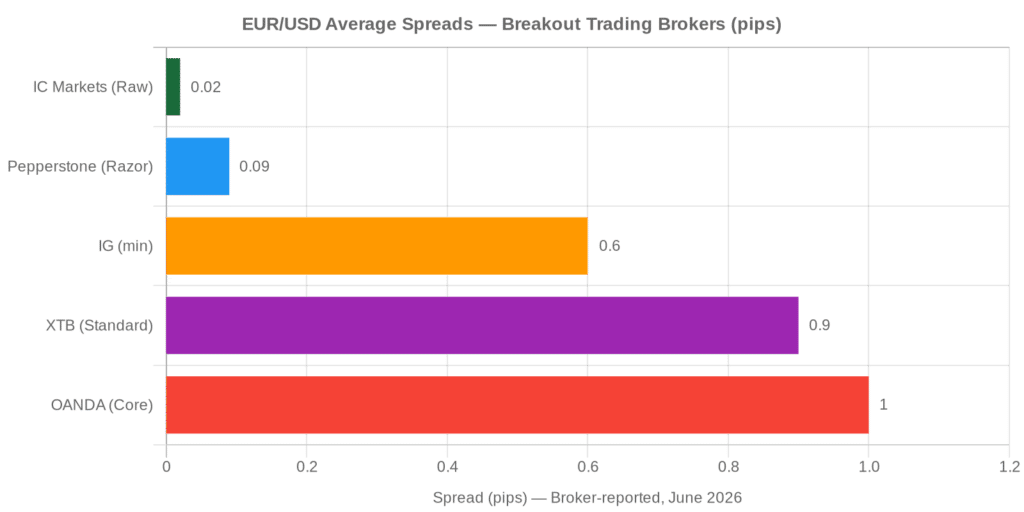
| Pepperstone | Overall breakout trading | 0.09 pips (Razor) | ECN/STP | FCA, ASIC |
| IC Markets | Lowest raw spread cost | 0.02 pips (Raw) | True ECN | ASIC, CySEC |
| XTB | Breakout stocks & indices | 0.9 pips (Standard) | Market maker + STP | FCA, KNF |
| OANDA | Beginner breakout traders | ~1.0 pips (Core) | Market maker | FCA, CFTC/NFA |
| IG | Equity DMA breakouts | 0.6 pips (min) | DMA/STP | FCA, ASIC |
What Makes a Broker Good for Breakout Trading?
Breakout traders enter when price clears a key level and exit quickly if the move reverses. That trading style punishes two things above all else: slow execution and wide spreads.
Execution speed matters because breakout candles move fast — a one-second delay at a key resistance level often means a 3–5 pip loss before the order fills. Spreads matter because you’re entering at the moment of maximum short-term volatility, exactly when many brokers widen their quotes.
A third factor that gets less attention: charting tools. Bollinger Bands squeeze detection, ATR-based position sizing, and volume overlay support need to be native — not an afterthought bolted onto a dated interface.
The 5 Best Brokers for Breakout Trading
1. Pepperstone — Best Overall
Pepperstone is the most complete option for traders running ECN pricing across forex, indices, and commodities without compromising on platform quality.
The Razor account delivers EUR/USD average spreads of 0.09 pips plus a $3.50 commission per lot per side (broker-reported, June 2026). Orders route through co-located servers at Equinix LD4 (London) and NY4 (New York) data centers, averaging under 40ms on most trade types. When price breaks through resistance at 14:02 London time and the whole Street is moving simultaneously, that infrastructure holds up.
Platform choice is wide: MT4, MT5, cTrader, and TradingView integrate natively. For breakout traders relying on Bollinger Band squeeze setups or volume-weighted signals, cTrader’s built-in algorithmic tools are worth the learning curve.
Pepperstone trails Interactive Brokers on listed equity coverage — if stock breakouts with DMA access are your focus, check IG first.
Regulation: FCA (No. 684312) | ASIC (No. 414530)
2. IC Markets — Best Raw Spread Cost
If you’re trading breakouts on tight major pairs — EUR/USD, USD/JPY, EUR/GBP — IC Markets’ True ECN account is the lowest-cost option available. Raw spreads average 0.02 pips on EUR/USD with a $3.50 commission per lot. Total round-trip cost on a standard lot: roughly $7.
Server infrastructure sits at Equinix NY4, the same data centre used by most major forex liquidity providers. Sub-1ms execution in ideal conditions. Most traders won’t notice the difference between sub-1ms and Pepperstone’s 40ms average — but high-frequency breakout strategies, where you’re pulling triggers across multiple pairs in quick succession, will.
The trade-off: IC Markets’ native interface lacks Pepperstone’s TradingView integration polish. MT4/MT5 or cTrader — that’s the choice. Fine for pure execution focus, less ideal if charting depth is a priority.
Regulation: ASIC (No. 335692) | FSA Seychelles
3. XTB — Best for Breakout Stocks and Indices
XTB doesn’t match Pepperstone or IC Markets on raw forex spreads. EUR/USD averages 0.9 pips on the Standard account. For CFD breakout trading across European and US equities, though, XTB’s coverage and xStation 5 platform are hard to beat at this tier.
xStation 5 includes a built-in market scanner that filters stocks by volatility surge, volume increase, and technical pattern proximity — exactly what you need when scanning 20 names for an opening range breakout. The scanner updates in real time.
Commission-free stock CFDs under €100,000 monthly volume also reduce the cost of taking multiple small breakout trades across different names. For breakout stocks and swing trading setups, this combination of scanner and cost structure works.
Check the full instrument list at xtb.com — European equity CFD coverage runs to 3,000+ instruments.
Regulation: FCA (No. 522157) | KNF Poland
4. OANDA — Best for Beginners
OANDA won’t win a speed test against IC Markets. EUR/USD averages around 1.0 pip on the Core account. For traders still learning to distinguish genuine breakouts from false ones, though, the platform’s tools are genuinely useful.
TradingView integration connects directly to breakout alert systems — setting up a Bollinger Band squeeze alert on EUR/USD took about two minutes in testing. OANDA also supports fractional lot sizing down to 0.001 lots, which lets new breakout traders practice entry-exit mechanics with real risk small enough to manage.
FCA-regulated (No. 542574) and CFTC/NFA-registered in the US, OANDA is also one of the few options for American traders who can’t access most ECN brokers due to regulatory restrictions. That’s a meaningful practical advantage.
Regulation: FCA (No. 542574) | CFTC/NFA
5. IG — Best for Equity Breakout Trading
IG is the right choice when equity breakouts — not forex — are the focus. The DMA (Direct Market Access) option routes orders directly to exchange order books for professional clients, bypassing IG’s dealing desk. For breakout trades on FTSE 100 constituents or US large-caps, the fill you see on Level 2 is the fill you get.
Forex spreads start at 0.6 pips minimum on EUR/USD (variable, widens during news). Less competitive than Pepperstone’s Razor on a like-for-like basis. But IG’s edge isn’t forex spreads — it’s the 17,000+ instrument range across shares, indices, forex, and commodities, and the DMA infrastructure for serious equity traders.
For multi-asset breakout strategies — running forex setups alongside equity breakouts in the same session — the breadth has real practical value.
Regulation: FCA (No. 195355) | ASIC (No. 515106)
What Is Breakout in Trading?
A breakout happens when price moves decisively outside a defined range — above resistance or below support — typically on a surge in volume. The market has been constrained, pressure has been building, and the breakout signals the constraint has broken.
Breakout trading captures that initial momentum: enter after the level clears, ride the follow-through, and exit at a target or when momentum fades.
Global daily forex turnover reached $7.5 trillion per the Bank for International Settlements’ 2022 Triennial Survey — a market where breakouts on major pairs can run 50–150 pips when the move carries institutional backing. The challenge is that most breakouts aren’t genuine. False breakouts — where price briefly pierces a level before reversing — are common on lower timeframes, particularly when volume is thin.
That’s why indicator confirmation and broker execution quality matter together, not independently.
Three tools do most of the work in breakout setups.
- Bollinger Bands show whether the market is coiling or expanding. When the bands tighten — the “squeeze” — volatility is low and a breakout is forming. The direction of the initial move gives the trade signal. Most experienced breakout traders don’t use Bollinger Bands to time the exact entry; they use them to identify when a setup is developing.
- Average True Range (ATR) measures volatility in absolute terms. A EUR/USD daily ATR of 70 pips means a “normal” day’s range is 70 pips — so a breakout needs at least 20–25 pips of follow-through distance before it’s statistically meaningful rather than noise. ATR also drives position sizing: a wider-ranging market needs a wider stop.
- Volume is the confirmation tool. A breakout on low tick volume is a candidate for reversal. Volume surging above its 20-period average as price clears resistance is the setup you want. Forex tick volume isn’t real volume — it measures price movement frequency rather than contract size — but it correlates well enough with institutional flow to serve as a useful proxy.
Breakout Trading Strategy: Entry, Exit, and Swing Setups
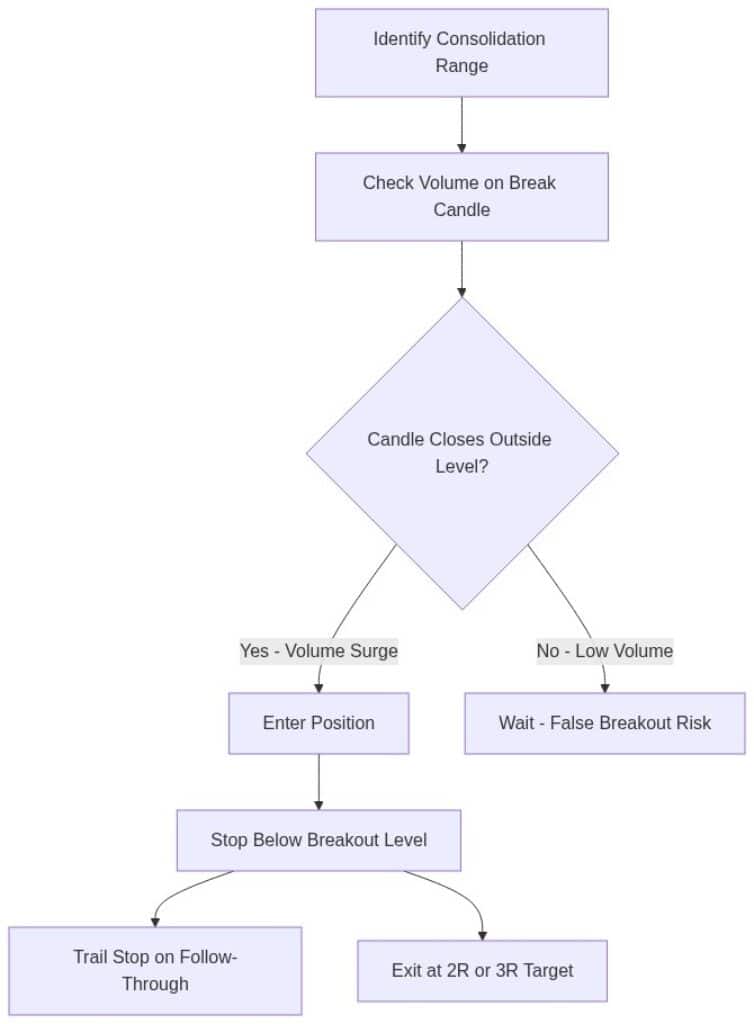
The cleanest breakout entry has three elements: a defined range (horizontal support/resistance or a trendline), a volume surge on the break candle, and a candle close outside the level — not just a wick.
Entry triggers above the breakout candle’s high (for longs) or below the low (for shorts). Stop goes below the most recent support. Targets are typically set at 1:2 or 1:3 risk-reward using ATR multiples.
For breakout stocks for swing trading, timeframes shift to daily and weekly charts. Swing breakout traders look for stocks consolidating in a tight range — low ATR relative to recent history — before a catalyst triggers the move: earnings, a sector rotation, or macro data. XTB’s market scanner identifies these setups efficiently; IG’s DMA execution handles the fills on UK and European names.
Holding period on swing breakout trades averages 2–10 days. The stop below the consolidation base is the critical discipline — a false breakout without a stop is where most accounts get damaged.
Conclusion
Pepperstone is the default for most breakout traders — ECN infrastructure, Razor account spreads, and a credible platform range make it hard to argue against. IC Markets takes the edge on raw forex spread cost alone; if you’re running high-frequency breakout setups across major pairs, that margin compounds.
For equity breakouts, IG’s DMA access is the serious option. For beginners learning the mechanics without blowing up, OANDA’s fractional sizing earns its keep despite the wider spreads.
The broker matters less than the strategy. But picking the wrong one will cost you on every single trade.
Frequently Asked Questions
1. What is a breakout in trading?
A breakout is when price moves outside a defined consolidation range — above resistance or below support — on expanding volume. It signals that buying or selling pressure has overcome the range boundary, typically triggering momentum follow-through. The key distinction from a false breakout: a candle close outside the level, not just a wick piercing it.
2. Which broker is best for breakout trading beginners?
OANDA for US-based traders and those learning breakout mechanics with small position sizes — the fractional lot sizing and alert tools make it practical to learn without oversizing. For non-US beginners who want tighter spreads as their strategy develops, Pepperstone’s Standard account is a reasonable starting point.
3. What are the best breakout trading indicators?
Bollinger Bands identify the squeeze before the move. ATR sizes positions and sets realistic targets. Volume confirms whether institutional money is behind the break. RSI divergence is a useful secondary check — a breakout where RSI is diverging against price is more likely to reverse.
4. Do breakout stocks work for swing trading?
They do, but context matters. Stocks breaking out of multi-week consolidation on above-average volume ahead of a catalyst have the cleanest follow-through. Breakouts on no news in low-volume conditions reverse more often than they don’t.
5. What is the risk of breakout trading?
The primary risk is false breakouts — price clears a level, triggers your entry, then reverses hard. This is why stop placement and position sizing matter more in breakout trading than almost any other strategy. Between 65% and 89% of retail accounts lose money trading CFDs, per FCA-regulated broker disclosures. Most of that loss comes from inadequate stops, not bad setups.
Risk warning: CFD trading involves significant risk of loss. Between 65% and 89% of retail investor accounts lose money trading CFDs, per FCA-regulated broker risk disclosures. Figures vary by broker. Breakout trading involves entering during volatile conditions — always use appropriate position sizing and stop-loss orders.
About Author