
Best MAM Account Brokers for Fund Managers
 Beatrice Quinn
 Robert J. Williams
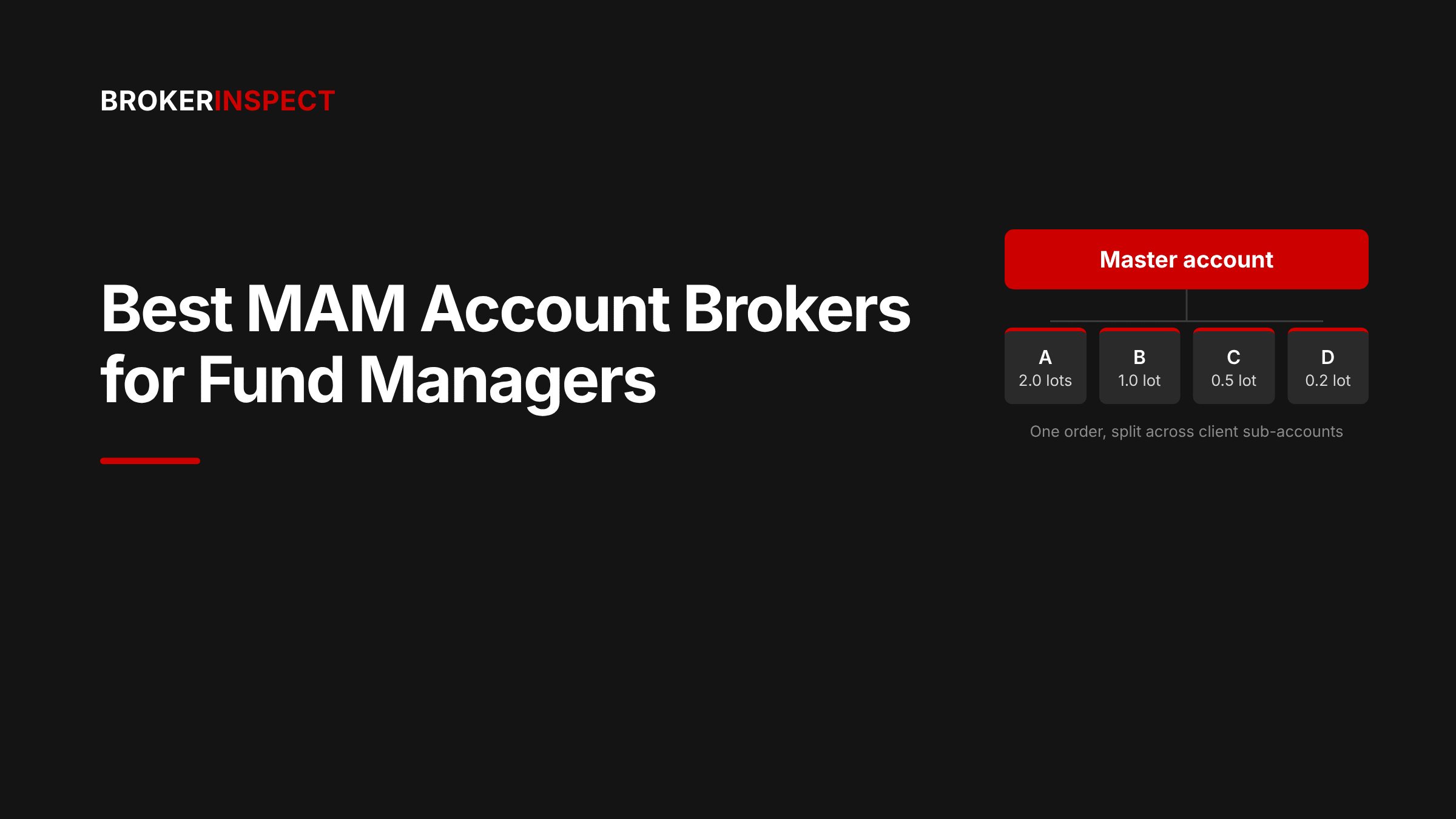
MAM account brokers let you trade for several clients at once, placing one order on a master account that the platform then copies into each client’s own account. This guide is written for the person doing the managing, not for the client handing over the money.
Below you’ll find how the allocation actually works, the checks to do before you commit a client book to a broker, five brokers who publish a MAM offering, and the licence you need before you take anyone’s money. For the investor’s view of pooled accounts, you can check out our guide on PAMM account brokers.
Key Takeaways
- A MAM account gives each client their own sub-account, so they keep control of deposits and withdrawals while you place the trades.
- The allocation method decides what each client trades, and support for the six common methods varies between brokers.
- MAM is usually offered by a broker’s offshore entity, so the protections your clients get may vary.
- Managing someone else’s money at your own discretion is a licensed activity in the UK, Australia, and the US.
- Every client signs a limited power of attorney that lets you trade the account without touching the funds.
What Is a MAM Account and How Does It Work?
A MAM account, short for multi-account manager, is a setup where one master trading account is linked to many client sub-accounts. You place a trade once, and the platform copies it into every linked account at a size that works out for each one.
The structure matters more than the software. Your client opens their own account with the broker, funds it themselves, and can withdraw from it whenever they want. You get trading rights over that account and nothing else, so the money never passes through your hands. The broker holds it, the client owns it, and you place the orders.
How a MAM Allocates One Trade Across Many Accounts
When you place an order on the master account, the MAM software calculates a position size for each sub-account and submits them together. A client with a larger balance takes a larger slice of the same trade.
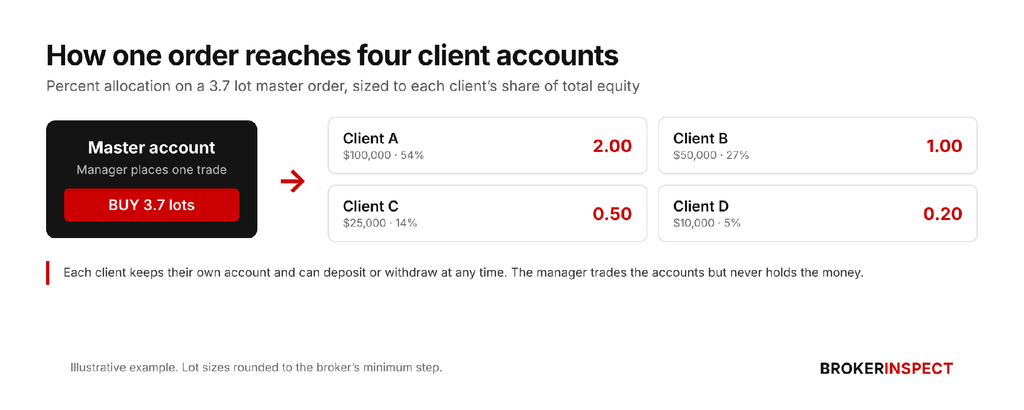
The method you choose decides how this split is calculated. Axi publishes six of them, which is a useful benchmark for comparing brokers: lot allocation, percent allocation, proportional by balance, proportional by equity, equity percent allocation, and allocation by equal risk (Axi).
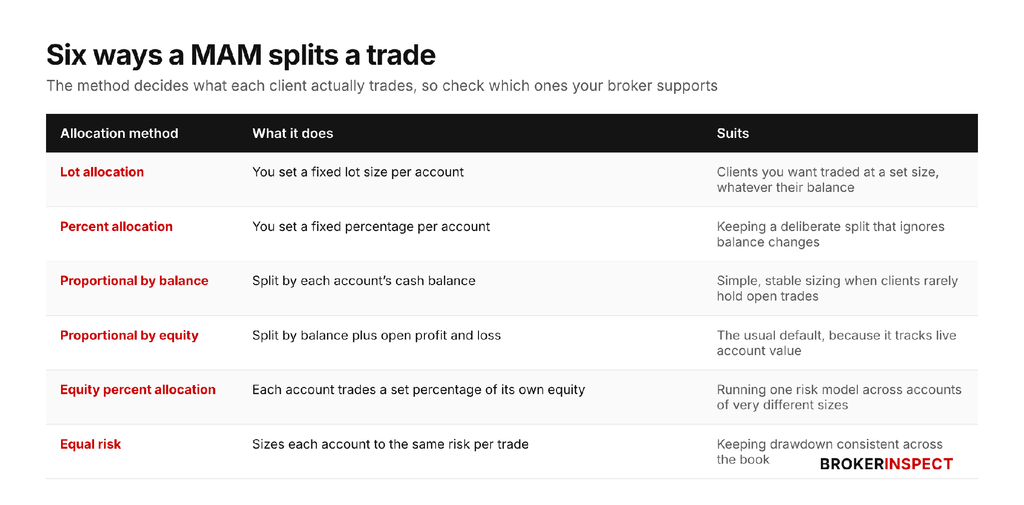
Many managers run proportional by equity because it tracks the live value of each account. Equal risk suits a book where account sizes differ sharply, and you want the same drawdown everywhere. The point is to confirm your broker supports the one your strategy needs, since a MAM that only splits proportionally will need you to change how you size trades.
PAMM vs MAM Account: Which One Fund Managers Need
A PAMM account pools client money into one fund and splits profit and loss by each investor’s share of it. A MAM keeps every client in a separate account and sizes their trades individually. Both differ from copy trading, where the client chooses to follow you and can stop at any time.
This separation is why most professional managers choose MAM. You can set a different allocation, a different leverage and a different stop level for each client, which a pooled structure can’t do. It also makes reporting cleaner, because each client reads their own account statement, not a share in a fund. PAMM is simpler to administer and still suits managers running one strategy for clients who want identical treatment.
What Fund Managers Should Check Before Choosing a MAM Broker
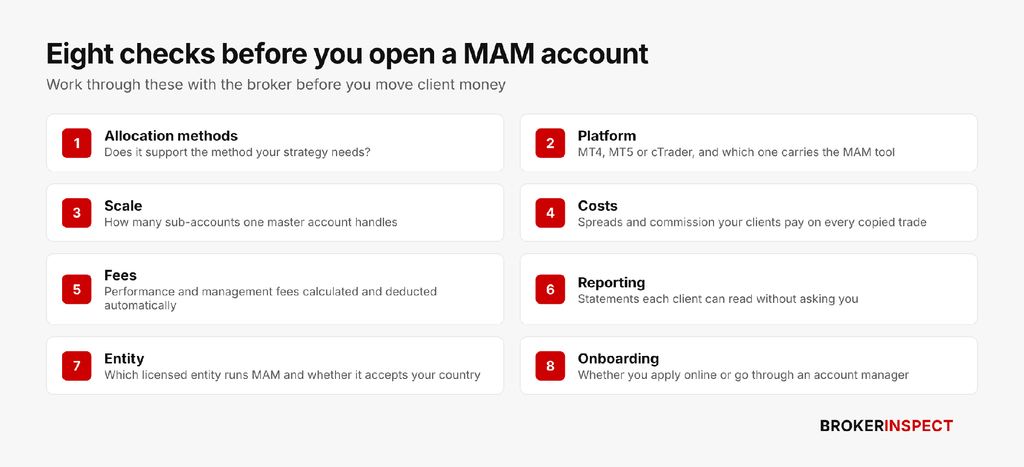
Judge a MAM broker on whether it can carry your client book. Eight things cover this well, before anything goes wrong:
- Allocation methods: Confirm the broker supports the specific method your strategy depends on, by name.
- Platform: MAM is most mature on MT4. Ask which platform carries the tool, since a broker can offer three platforms and run MAM on only one.
- Scale: Ask how many sub-accounts fill in a single pass, and what happens to the allocation when one account is rejected for margin.
- Costs your clients pay: Spread and commission apply to every copied trade, so a wide spread multiplies across the whole book. An ECN broker usually suits a managed book better.
- Fee automation: Performance and management fees should be calculated per sub-account and deducted automatically. Manual invoicing across thirty clients becomes its own job.
- Client reporting: Each client should be able to read their own statement without asking you for it.
- Which entity runs it: MAM often sits with a broker’s offshore arm, so check which licensed company your clients contract with and whether it accepts residents of their country.
- Onboarding route: Some brokers take an online application, while others route you through an account manager and a review of your trading record.
Best MAM Account Brokers for Fund Managers
The five forex MAM brokers below publish a multi-account manager offering aimed at money managers. We checked each one against the broker’s own live pages in October 2026, and dropped two well-known names whose manager programmes have changed since they were last written about.
| Broker | Licensed entity for MAM | Platform | What stands out |
| FP Markets | FP Markets LLC (St Vincent and the Grenadines) | MT4 and MT5 | Documents its MAM process clearly, including the power of attorney step |
| Axi | AxiTrader LLC (St Vincent and the Grenadines) | MT4 | Names all six allocation methods and takes an online application |
| ATFX | Group entities under FCA, CySEC and the Mauritius FSC | MetaTrader | The FCA-regulated arm serves professional clients only |
| BlackBull Markets | BBG Limited | MT4 and MT5 | Publishes its full MAM agreement, including the conflict of interest wording |
| Errante | Errante Securities (Seychelles) Ltd, FSA licence SD038 | MT4, MT5 and cTrader | Offers a choice of allocation methods and cTrader alongside MetaTrader |
FP Markets
FP Markets sets up the sub-accounts for your clients and copies each master trade into them by lot size, with profit and loss split according to each sub-account’s share of total equity. You can adjust allocation percentages, give individual sub-accounts different volumes, or group them to run more than one strategy. Performance fees are set per sub-account and deducted from profits automatically.
What it documents best is the sequence. Trading starts only once the limited power of attorney between you and each client is signed, and clients can watch their accounts in real time without being able to close your trades. Our review of FP Markets covers its spreads and execution in detail.
Axi
Axi runs its MAM on MT4 and is the clearest of the five about how trades are divided, publishing all allocation methods by name. You set your own performance and management fees, oversee the accounts from one interface, and apply online without going through a sales call.
The trade-off here is the entity. MAM is with AxiTrader LLC, registered in St Vincent and the Grenadines, and not with the group’s ASIC- or FCA-regulated arms, so your clients deal with an offshore company. Our Axi review offers complete information on its trading conditions.
ATFX
ATFX copies master trades to sub-accounts by lot allocation and distributes profit and loss by each account’s share of equity, with custom performance fees per client that the system deducts from profits. It’s a reasonable fit for managers who want a group with presence in several regulated markets.
Read the entity structure carefully. AT Global Markets (UK) Ltd is FCA-authorised but serves professional clients only, while other group companies are under CySEC and the Mauritius FSC. Which one your clients sign with determines what protection they have.
BlackBull Markets
BlackBull supports MAM accounts through its client portal and is unusual in publishing the full Multi-Account Manager Agreement. This spells out the power of attorney and states plainly that a manager earning commission while trading a client’s account under that authority carries an inherent conflict of interest.
This transparency is worth noting. You can show a document to a prospective client, in place of a page of marketing claims, thus shortening the conversation about what you can and can’t do with their account.
Errante
Errante gives managers a central dashboard for multiple accounts with a choice of allocation methods. It is the only broker of the five that offers cTrader alongside MT4 and MT5. This matters if your strategy or execution analysis depends on cTrader rather than MetaTrader.
The MAM service is provided by Errante Securities (Seychelles) Ltd under FSA licence SD038. The group’s CySEC-regulated company is a separate entity, and the broker restricts a long list of countries, so check your clients’ residency before you promise anything.
| What our team sees when managers switch brokers The same few problems come up whenever a manager moves a book: • The allocation method is missing: The broker supports MAM but not the specific method the manager has been sizing trades with, which changes every client’s risk without anyone noticing. • The entity isn’t the one on the website: A manager assumes they are dealing with the FCA-regulated company and finds the MAM contract names an offshore arm. • Fees are manual: Performance fees have to be invoiced by hand, which is fine for five clients but troublesome at thirty. • Clients can’t see anything: Without client-facing statements, every month ends with the manager assembling reports when they should be trading. |
Do You Need a Licence to Run a MAM Account?
You do in most of the major markets. Trading someone else’s account at your own discretion is a regulated activity, and opening a MAM account with a broker does nothing to authorise you for it.
How the UK, Australia and the US Treat It
In the UK, the FCA treats managing investments as regulated where you exercise discretion over the composition of a portfolio that belongs to someone else. Non-discretionary management, where you only act on the client’s instructions, falls outside that particular activity, though another one may still apply (FCA Handbook, PERG 2.7).
In Australia, every managed discretionary account provider has needed an Australian financial services licence with a specific authorisation since 1 October 2018, when ASIC’s transition period ended (ASIC).
In the US, the National Futures Association defines a commodity trading advisor as anyone who, for compensation or profit, advises others on futures, options, retail forex or swaps, and says that exercising trading authority over a customer’s account counts as advising directly (NFA). That normally means registering with the CFTC and joining the NFA.
Elsewhere the picture varies, which is part of why so many MAM services run through offshore entities. An offshore broker will open the account. It won’t make you lawful in the country where your clients live, and the regulator that matters is theirs.
Power of Attorney and Allocation Records
Every MAM relationship runs on a limited power of attorney. Your client signs it, and it gives you authority to trade the account while leaving deposits and withdrawals with them. BlackBull’s published agreement goes further than most by stating that a manager who earns fees from trading a client’s account under that authority has an inherent conflict of interest, which is exactly the thing worth putting in front of a client early.
Your allocation settings are a compliance record as well as a trading tool. In the US, CFTC Regulation 1.35 governs bunched orders and requires allocations to be fair and documented. Allocating profitable fills to favoured accounts is cherry-picking, and regulators pursue it. The SEC charged a Wisconsin adviser in June 2015 for routing winning option trades to his own accounts and losing ones to clients, in the first case from a programme built to detect the practice in trading data.
“Cherry-picking schemes can be extremely difficult to detect without an investor astutely noticing…”
Julie M. Riewe, Co-Chief, SEC Enforcement Division Asset Management Unit, June 2015
The practical defence is dull and effective. Set your allocation method before the trade, let it be, and keep the statements the platform produces.
Conclusion
Choosing among MAM account brokers comes down to three things: whether the platform splits trades the way your strategy needs, which licensed entity your clients will actually contract with, and whether you are authorised to manage their money in the first place. Get the third one settled before the other two, then work through the eight checks with whichever broker you shortlist.
FAQs
How much capital do I need to start a MAM account?
Most brokers don’t publish a figure, because they set it case by case against your experience and the size of your client book. Expect the master account to need meaningful funding of its own, and expect each client sub-account to meet the broker’s normal minimum. Ask for both numbers in writing before you apply.
Can I run a MAM account on MT5 or cTrader?
Sometimes. MAM grew up on MT4, and that remains the most widely supported platform, though several brokers now offer it on MT5 as well. cTrader support is less common and usually arrives under a different name. Confirm the platform before you build a strategy around a tool your broker doesn’t carry.
When is a performance fee calculated and deducted?
Typically at the end of each period you agree with the client, on profit above the account’s previous high point, so you aren’t paid twice for recovering the same loss. The platform works it out per sub-account and takes it from that client’s profit. Ask whether the calculation uses closed trades only.
Can US residents invest in a MAM account?
Rarely through an offshore broker. Most firms offering MAM exclude US residents, and anyone soliciting US clients to manage their forex trading generally needs to register with the CFTC and join the NFA. If your client base is American, take advice before you accept a single account.
How many sub-accounts can one master account handle?
Brokers usually quote a technical limit in the hundreds, and some advertise no cap at all. The practical limit arrives sooner. Every extra account adds execution load at the moment you trade, so ask the broker how many accounts its system fills in one pass and how it handles partial fills.
What happens to client accounts if I stop managing them?
The sub-accounts stay with the client, because the money was not yours. Once the power of attorney ends, your trading access is switched off, and the client keeps the account, the balance, and any open positions. Agree in advance who closes those positions, since an unmanaged trade can run for days.
About Author